2026-07-01 北海道大学
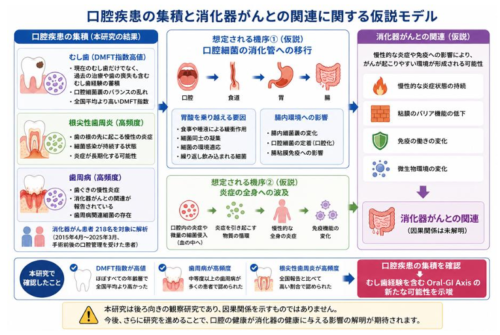
研究仮説の概要図
<関連情報>
- https://www.huhp.hokudai.ac.jp/wp-content/uploads/2026/07/press_20260701.pdf
- https://www.mdpi.com/2072-6694/18/12/1941
消化器がん患者における口腔疾患の包括的評価:10年間の後ろ向き研究から得られた疫学的知見 Comprehensive Evaluation of Oral Diseases in Patients with Gastrointestinal Cancers: Epidemiological Evidence from a 10-Year Retrospective Study
Chiharu Kawamoto,Hirofumi Kaneko,Ryotaro Yago,Yudai Matsuo,Yuto Nakamura,Takuma Mirokuin,Shuhei Hoshika,Hidehiko Sano,Atsushi Tomokiyo andNaoya Sakamoto
Cancers Published: 14 June 2026
DOI:https://doi.org/10.3390/cancers18121941
Abstract
Background: The association between oral health and gastrointestinal (GI) cancers has been primarily investigated within a periodontitis-centered framework. However, the potential contribution of cumulative oral disease burden, including dental caries and apical pathology, remains insufficiently explored. The Decayed, Missing, and Filled Teeth (DMFT) index reflects lifetime exposure to oral microbial dysbiosis and chronic inflammation.
Methods: This retrospective exploratory study included patients with GI cancers referred for perioperative oral screening and management at a tertiary care center between 2015 and 2025. Oral health was evaluated using the DMFT index, periodontal probing depth, and radiographically diagnosed apical periodontitis. Age-stratified DMFT and periodontal parameters were compared with national reference data, while apical periodontitis prevalence was descriptively assessed.
Results: Patients with GI cancers demonstrated higher DMFT values than national averages across most adult age groups. The prevalence of periodontal pockets (≥4 mm and ≥6 mm) was also elevated. Apical periodontitis was common, affecting 46.3% of patients, with some age groups exceeding 50%. Overall, these findings indicate oral disease clustering with coexisting chronic oral conditions.
Conclusions: Patients with GI cancers exhibit substantial oral disease burden, including increased caries experience, periodontal pathology, and apical lesions. These findings suggest that the oral–gastrointestinal cancer relationship may extend beyond a periodontitis-centered paradigm, and that cumulative oral disease burden—including cariogenic processes—may represent an underrecognized component of this axis. The DMFT index may serve as a surrogate marker of lifelong oral inflammatory exposure. While causal relationships cannot be established, this study provides a basis for future mechanistic and longitudinal investigations.