2026-07-02 スタンフォード大学
<関連情報>
- https://news.stanford.edu/stories/2026/07/dengue-road-development-peruvian-amazon
- https://www.nature.com/articles/s41893-026-01879-8
ペルーのアマゾン地域で高速道路舗装工事後にデング熱の感染が増加 Increased dengue transmission following highway paving in the Peruvian Amazon
Alyson L. Singleton,Andres G. Lescano,Kevin S. Martel,Andrew J. MacDonald,Lisa Mandle,Terrell J. Sipin,Ana S. M. Bautista,Esteban D. R. Carrera,Gustavo A. Choque,César V. Munayco,Stephen P. Luby & Erin A. Mordecai
Nature Sustainability Published:02 July 2026
DOI:https://doi.org/10.1038/s41893-026-01879-8
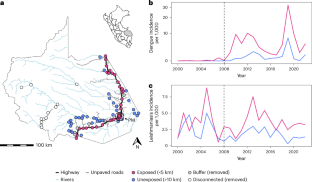
Fig. 1: Study design and disease incidence before and after highway paving.
Abstract
Rapid expansion of transportation infrastructure is transforming tropical environments, yet the health impacts of these changes remain poorly understood and are rarely accounted for in impact assessments. We apply a quasi-experimental approach to quantify the impact of highway paving on infectious disease transmission. The 2009 paving of the Interoceanic Highway through the previously isolated Madre de Dios region of the Peruvian Amazon offered a natural experiment to evaluate how highway paving influences transmission of dengue virus, a high-burden mosquito-borne disease. We compared dengue incidence data from healthcare facilities in Madre de Dios near versus far from the highway before and after paving, while controlling for observable and unobservable confounding variables (a difference-in-differences causal inference approach). Paving led to an additional 10,950 (95% confidence interval of 3,186–18,715) dengue cases since 2009, a 403% (117–689%) increase in incidence rates in facilities near the highway in the 14 years since paving (2009–2022), compared with their pre-paving incidence rates. Our findings demonstrate the impact that infrastructure can have on dengue transmission, likely via its effects on human mobility and vector dispersal. Future road construction plans in tropical regions should account for potential increases in dengue transmission during impact assessments.