2026-08-26 カロリンスカ研究所(KI)
<関連情報>
- https://news.ki.se/new-clues-about-the-causes-of-severe-headaches
- https://journals.sagepub.com/doi/10.1177/03331024261480707
- https://link.springer.com/article/10.1186/s10194-026-02485-x
群発頭痛における重金属曝露およびDNAメチル化のマーカー増加 Increased markers of heavy metal exposure and DNA methylation in cluster headache
Joseph Lloyd, Katrin Wellfelt, […], and Andrea Carmine Belin
Cephalalgia Published:August 25, 2026
DOI:https://doi.org/10.1177/03331024261480707
Abstract
Background/Hypothesis
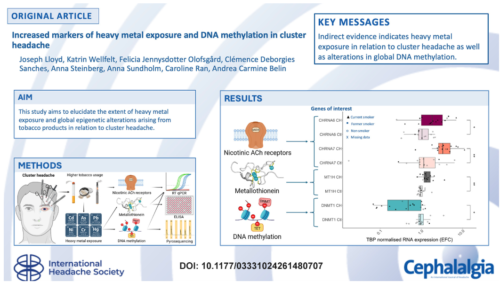
Rates of tobacco usage are higher in individuals with cluster headache. Tobacco usage exposes the user to a large variety of toxic compounds, detrimental to health, including heavy metals. We hypothesise that exposure to heavy metals through tobacco usage will drive epigenetic alterations in individuals with cluster headache.
To elucidate the extent of heavy metal exposure and global epigenetic alterations arising from tobacco products in relation to cluster headache we performed a case-control study, using DNA methylation, gene and protein expression analysis to evaluate markers for smoking, epigenetic modifications and heavy metal exposure.
Methods
RNA was purified from collected blood samples from 16 cluster headache participants and 16 control participants, converted to cDNA, and RNA expression quantified via RT-qPCR. This was done by investigating genes relevant for nicotine exposure; nicotinic acetylcholine receptors (nAChRs), heavy metal exposure; metallothionein (MT) family, markers of liver and kidney damage (ALT, Alb and NGAL), epigenetic enzymes for DNA methylation (DNMTs) and demethylation (TETs), normalized to the housekeeping gene TBP. MT3 protein expression was quantified using an ELISA kit in cerebrospinal fluid from 13 cluster headache participants and 13 control participants. The methylation status of CpG-rich regions of long-interspersed nucleotide element-1 (LINE-1), in bisulfite converted DNA of 20 smoking individuals with cluster headache, 33 non-smoking individuals with cluster headache and 26 control participants, was quantified by pyrosequencing.
Results
An increased RNA expression of nicotinic acetylcholine receptor subunits CHRNA6 and CHRNA7 was found in the cluster headache group compared to controls. Additionally, there were an increased RNA expression of MT1H and increased protein levels of MT3 along with a decreased RNA expression of DNMT1. A positive correlation was found between the RNA expression of CHRNA7 and MT1H and a negative correlation was found between CHRNA6 and DNMT1.
Conclusion
Indirect evidence indicates heavy metal exposure in relation to cluster headache as well as a tendency for alterations in global DNA methylation. This supports the hypothesis that heavy metal exposure from smoking contributes towards the pathophysiology of cluster headache.
群発頭痛のゲノムワイド関連感受性遺伝子座は、炎症が病態生理に関与していることを示唆している Genome-wide association susceptibility loci for cluster headache support a role for inflammation in the pathophysiology
Caroline Ran,Clémence Deborgies Sanches,Julia Swedblom,Katrin Wellfelt,Alessandro Antoniazzi,Joseph Lloyd,Felicia Jennysdotter Olofsgård,Stefan Spulber,Elisabet Waldenlind,Maria Lantz,Anna Steinberg,Anna Sundholm,Christina Sjöstrand & Andrea Carmine Belin
The Journal of Headache and Pain Published:04 August 2026
DOI:https://doi.org/10.1186/s10194-026-02485-x
Abstract
Background
Recent genetic findings have broadened the perspectives of cluster headache pathophysiology. Genes identified by genome wide association studies are likely to be involved in the pathophysiological mechanisms underlying the disease. In this study, we performed validation and characterization of eight loci corresponding to nine genes identified in previous genome wide association studies.
Methods
Genetic loci were validated by means of a case-control study using TaqMan genotyping in 671 individuals, and a meta-analysis using previously genotyped data. Pyrosequencing methylation analysis and reverse transcription quantitative PCR gene expression studies was performed in a subset of individuals with cluster headache and healthy controls.
Results
Genetic associations were found with functional variants in two genes; FHL5 and MERTK. The minor allele of the FHL5 variant rs2273621 was associated with an increased risk of cluster headache in the genotyped samples (odds ratio = 1.42, P = 0.03) and in a meta-analysis (odds ratio = 1.29, confidence interval: 1.09–1.52), and the minor allele of the rs2230515 variant in MERTK was associated with lower risk in the meta-analysis (odds ratio = 0.69, confidence interval: 0.52–0.92). Methylation analysis further revealed altered methylation status of MERTK. Moreover, changes in relative gene expression were found for several candidate genes: a decrease in the mRNA expression of DUSP10 (P < 0.001), CAPN2 (P < 0.001), UFL1 (P < 0.001) and LRP1 (P = 0.007) in blood, and a decrease of CAPN2 (P < 0.001) as well as an increase in the mRNA expression of FTCDNL1/FONG (P = 0.004) in fibroblasts in CH vs. controls. Only two genes; PLCE1 and WNT2, could not be validated in the biological tissue studied; WNT2, possibly due to limited power, while PLCE1 was not expressed in the available tissue.
Conclusions
These results confirm the validity of seven candidate genes for cluster headache identified through GWAS. Furthermore, five of the candidate genes are abundantly expressed in both immune and blood cells, converge functionally on inflammatory signalling pathways and suggest a potential role for inflammasomes in cluster headache.