2026-09-25 マウントサイナイ医療システム(MSHS)
<関連情報>
- https://www.mountsinai.org/about/newsroom/2026/mount-sinai-study-identifies-why-some-patients-develop-severe-intestinal-inflammation-after-car-t-therapy
- https://www.nature.com/articles/s41591-026-04632-y
BCMA CAR-T細胞療法に関連する腸炎における粘膜CAR-T細胞の持続性と炎症性リモデリング Persistence of mucosal CAR-T cells and inflammatory remodeling in enterocolitis associated with BCMA CAR-T cell therapy
Nikhit Kethidi, Saumya Pothukuchi, Adolfo Aleman, Daniel Charytonowicz, Christina Kuhn, Thomas Wong, Jennifer Claytor, Pablo Canales-Herrerias, Samane Khoshbakht, Akanksha Acharya, Michael Tankelevich, Tin Htwe Thin, Divya Jha, Matthias Ceulemans, Alexandra E. Livanos, Catherine Le Berre, Zachary M. Avigan, Luise Fischer, Jacqueline E. Birkness-Gartman, Joanna Melia, Yimei Jin, Rachel Chen, Isha Parikh, Meenakshi Mehrotra, … Saurabh Mehandru
Nature Medicine Published:23 September 2026
DOI:https://doi.org/10.1038/s41591-026-04632-y
Abstract
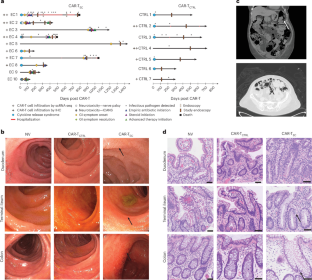
B cell-targeted therapies are expanding across oncologic and autoimmune indications, yet their consequences for mucosal immunity remain incompletely examined. Here we define the pathophysiology of ciltacabtagene autoleucel chimeric antigen receptor (CAR)-T cell-induced enterocolitis (EC) (CAR-TEC)—a severe complication of B cell maturation antigen-targeted CAR-T cell therapy in multiple myeloma. Using single-cell transcriptomics, flow cytometry and tissue imaging of intestinal biopsies from patients with CAR-TEC (n = 10), CAR-T cell-treated controls without EC (n = 7) and healthy volunteers (n = 26), we identify profound depletion of mucosal B cells and plasma cells accompanied by expansion of highly cytotoxic CAR-T cells and inflammatory myeloid, stromal and glial cell remodeling to be associated with CAR-TEC. Cell–cell communication analyses suggest a compensated mucosal state in CAR-T cell-treated controls, telocyte-driven stromal niche dysfunction as noted in CAR-TEC. Interferon- and Janus kinase (JAK) and signal transducer and activator of transcription-associated reprogramming was noted across stromal, endothelial and epithelial compartments, supporting JAK inhibition as a rational, mechanism-based therapeutic strategy. Upadacitinib—an oral selective JAK 1 inhibitor—resulted in clinical, endoscopic and histologic improvement in two people with CAR-TEC. Our findings define CAR-TEC as a multicompartment syndrome of severe mucosal dysregulation with implications for the emerging field of B cell-targeted therapies.