2025-06-20 中国科学院(CAS)
<関連情報>
- https://english.cas.cn/newsroom/research_news/life/202506/t20250620_1045904.shtml
- https://academic.oup.com/schizophreniabulletin/advance-article/doi/10.1093/schbul/sbaf087/8161280
統合失調症における小脳-大脳基底核結合障害:意欲障害への洞察 Cerebellar–Basal Ganglia Dysconnectivity in Schizophrenia: Insights into Motivational Deficits
Xuan Wang , Xiao-dong Guo , Xin-lu Cai , Bing-jie Huang , Yi Wang , Cheng-cheng Pu , Xin Yu , Simon S Y Lui , Raymond C K Chan
Schizophrenia Bulletin Published:13 June 2025
DOI:https://doi.org/10.1093/schbul/sbaf087
Abstract
Background and Hypothesis
Motivational deficits are core negative symptoms of schizophrenia (SCZ), which have been linked to disruptions in reward network. Recent evidence suggests the cerebellum’s role in motivational and hedonic processing. This study examined its connectivity with the reward network in SCZ and hypothesized that decreased connectivity would be found in SCZ patients and correlated with severe negative symptoms.
Study Design
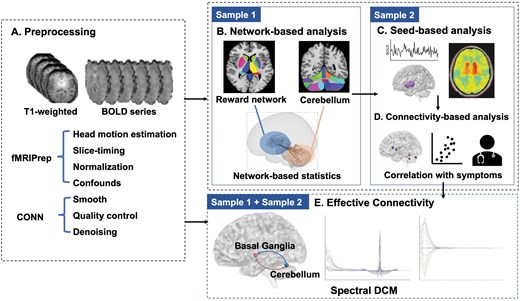
This study employed a cross-sample validation approach using 2 independent cohorts (Sample 1: NSCZ = 62, NHC = 61; Sample 2: NSCZ = 53, NHC = 55). Resting-state functional connectivity was assessed using network-based analysis to identify disrupted subnetworks, followed by seed-based connectivity analysis to localize specific connections. Effective connectivity was assessed using spectral Dynamic Causal Modeling (DCM) for inferring the directional influences of abnormal connectivity related to amotivation or anhedonia.
Study Results
Network-based analysis in Sample 1 identified a disrupted subnetwork between the cerebellum (lobules VI, VIIb, VIII) and basal ganglia (putamen, caudate, pallidum) in SCZ, with cerebellar–pallidal connectivity associated with amotivation. Seed-based analysis in Sample 2 revealed reduced putamen/caudate-lobule VI connectivity, correlating with amotivation and anhedonia symptoms in SCZ. Spectral DCM indicated reduced excitatory input from cerebellum to the basal ganglia in Sample 1, but such results could not be replicated in Sample 2.
Conclusions
Our findings highlighted the role of cerebellum–basal ganglia connectivity in the pathophysiology of SCZ, particularly in relation to amotivation and anhedonia. This pathway may be a putative target for neuromodulation to ameliorate negative symptoms of SCZ.