2025-07-18 中国科学院(CAS)
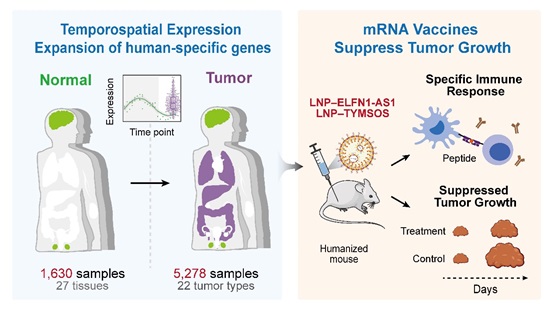
Oncogenic roles of young human de novo genes (Image by IGDB)
<関連情報>
- https://english.cas.cn/newsroom/research_news/life/202507/t20250718_1047649.shtml
- https://www.cell.com/cell-genomics/fulltext/S2666-979X(25)00184-3
若いヒトde novo遺伝子の発がん的役割とがん免疫療法におけるネオアンチゲンとしての可能性 Oncogenic roles of young human de novo genes and their potential as neoantigens in cancer immunotherapy
Chunfu Xiao ∙ Xiaoge Liu ∙ Peiyu Liu ∙ … ∙ Qiang Cheng ∙ Ni A. An ∙ Chuan-Yun Li
Cell Genomics Published:July 17, 2025
DOI:https://doi.org/10.1016/j.xgen.2025.100928
Highlights
- 37 young human de novo genes with clear evolutionary trajectories are identified
- These genes show temporospatial expression expansion across tumors
- Depletion of 57.1% of these genes suppresses tumor cell proliferation
- mRNA vaccines expressing two young genes trigger specific immune responses
Summary
Young human de novo genes, recently emerging from non-coding regions, are expected to contribute to human-specific traits and diseases. However, systematic explorations of this connection have been lacking. Here, we report 37 recently originated de novo genes in humans, with their evolution and characteristics defined within an updated genomic context. The expression of these genes is significantly upregulated and temporospatially expanded in tumors, partially associated with extrachromosomal DNA amplification. Depletion of 57.1% of these genes suppresses tumor cell proliferation, underscoring their roles in tumorigenesis. As a proof of concept, we developed mRNA vaccines expressing ELFN1-AS1 and TYMSOS—young genes specifically expressed during early development but reactivated exclusively in tumors. In humanized mice, these vaccines triggered specific T cell activation and inhibited tumor growth. The antigens derived from these genes are immunogenic and capable of eliciting antigen-specific T cell activation in colorectal cancer patients. These findings underscore young human de novo genes as neoantigens in cancer immunotherapy.