2025-07-23 理化学研究所,京都大学
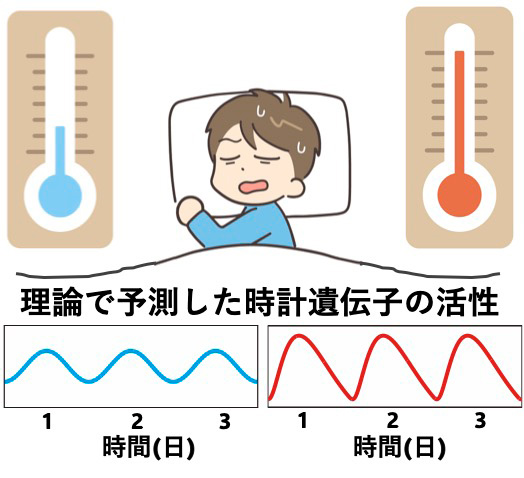
体内時計の仕組み: 高温で遺伝子活性の波形がひずむことで周期を保つという理論とその検証
<関連情報>
- https://www.riken.jp/press/2025/20250723_1/index.html
- https://journals.plos.org/ploscompbiol/article?id=10.1371/journal.pcbi.1013246
概日リズムにおける温度補償と同調のための波形の歪み: 繰り込み群法に基づくアプローチ Waveform distortion for temperature compensation and synchronization in circadian rhythms: An approach based on the renormalization group method
Shingo Gibo ,Teiji Kunihiro,Tetsuo Hatsuda,Gen Kurosawa
PLOS Computational Biology Published: July 22, 2025
DOI:https://doi.org/10.1371/journal.pcbi.1013246
Abstract
Numerous biological processes accelerate as temperatures increase, but the period of circadian rhythms remains constant, known as temperature compensation, while synchronizing with the 24h light-dark cycle. We theoretically explore the possible relevance of waveform distortions in circadian gene-protein dynamics to the temperature compensation and synchronization. Our analysis of the Goodwin model provides a coherent explanation of most of temperature compensation hypotheses. Using the renormalization group method, we analytically demonstrate that the decreasing phase of circadian protein oscillations should lengthen with increasing temperature, leading to waveform distortions to maintain a stable period. This waveform-period correlation also occurs in other oscillators like Lotka-Volterra, van der Pol models, and a realistic model for mammalian circadian rhythms. A reanalysis of known data nicely confirms our findings on waveform distortion and its impact on synchronization range. Thus we conclude that circadian rhythm waveforms are fundamental to both temperature compensation and synchronization.
Author summary
Our daily rhythms are underlain by gene regulatory and biochemical networks, called circadian clocks. Although most biochemical reactions accelerate as temperature increases, the period of circadian rhythms is almost constant even with increasing temperature. This phenomenon is called temperature compensation, and the mechanism is still unclear. By applying a method of theoretical physics, the renormalization group method to a biological problem, we revealed that the waveform of gene dynamics should be more distorted from sinusoidal wave at higher temperature when the circadian period is stable to changes in temperature. This prediction as for the importance of waveform in temperature compensation is verified by analyzing published experimental data of Drosophila and mice. Notably, the correlation between period and waveform distortion holds for other oscillator models, indicating the waveform distortion is important for determining the period in various types of oscillatory systems. Another important challenge in understanding circadian clocks is how they synchronize with environmental light-dark cycles. By theoretically analyzing a circadian clock model, we found that the frequency range for synchronization becomes narrower when the waveform is distorted.