2025-08-01 ワシントン大学セントルイス校
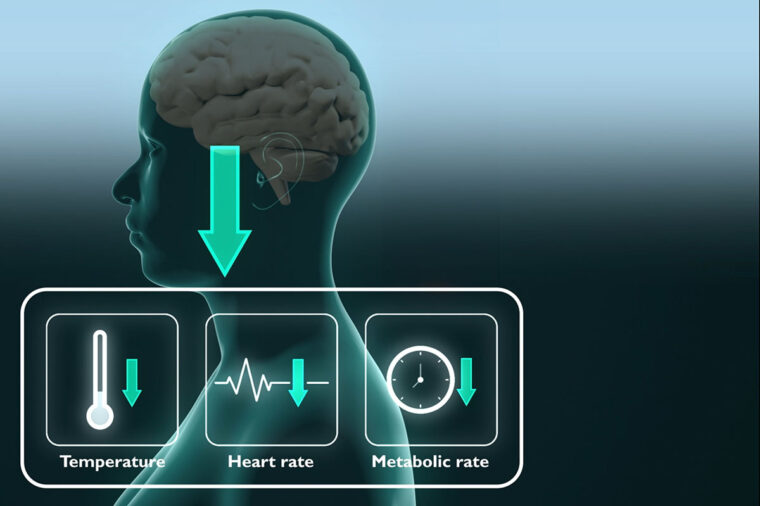
A team of researchers at Washington University in St. Louis is in pursuit of translating induced, or synthetic, torpor into potential solutions for humans, such as when there is reduced blood flow to tissues or organs, to preserve organs for transplantation or to protect from radiation during space travel. (Image: Chen lab)
<関連情報>
- https://source.washu.edu/2025/08/washu-expert-synthetic-torpor-has-potential-to-redefine-medicine/
- https://engineering.washu.edu/news/2025/WashU-Expert-Synthetic-torpor-has-potential-to-redefine-medicine.html
- https://www.nature.com/articles/s42255-025-01345-3
合成性冬眠:医療イノベーションのための代謝調節の進展 Synthetic torpor: advancing metabolic regulation for medical innovations
Wenbo Wu,Genshiro A. Sunagawa & Hong Chen
Nature Metabolism Published:31 July 2025
DOI:https://doi.org/10.1038/s42255-025-01345-3
Abstract
Torpor is a naturally occurring state of metabolic suppression that enables animals to adapt and survive extreme environmental conditions. Inspired by this adaptation, researchers have pursued synthetic torpor—an artificially induced, reversible hypometabolic state with transformative medical potential. Achieving synthetic torpor has been pursued for over a hundred years, with earlier work focused on identifying drugs for systemically suppressing metabolism. Breakthroughs in 2020 identified key torpor-regulating neurons in mice, opening new opportunities for neuromodulation-based metabolic control. Synthetic torpor has been applied in animal models for various medical applications, including ischaemic protection, organ preservation, radiation protection and lifespan extension. This Perspective examines the fundamental concepts of natural torpor, advances in approaches to induce synthetic torpor and medical applications of synthetic torpor. The capability of synthetic torpor to suppress whole-body metabolism has the potential to transform medicine by offering novel strategies for medical interventions.