2025-09-18 ジョージア工科大学
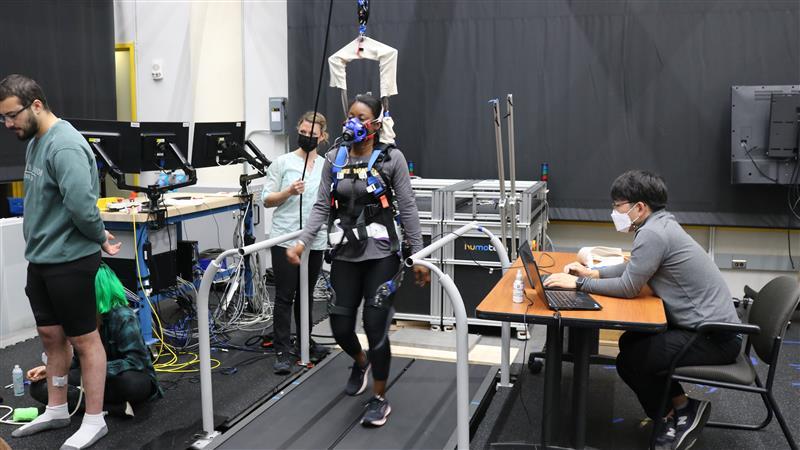
Georgia Tech’s AI-fueled exoskeleton adapts to every step, helping patients relearn to walk with less effort and more confidence.
<関連情報>
- https://research.gatech.edu/robotic-breakthrough-could-help-stroke-survivors-reclaim-their-stride
- https://ieeexplore.ieee.org/abstract/document/11112638
オンライン適応フレームワークにより、脳卒中患者の歩行中の外骨格支援の個別化が可能に Online Adaptation Framework Enables Personalization of Exoskeleton Assistance During Locomotion in Patients Affected by Stroke
Inseung Kang; Dean D. Molinaro; Dongho Park; Dawit Lee; Pratik Kunapuli; Kinsey R. Herrin,…
IEEE Transactions on Robotics Published:04 August 2025
DOI:https://doi.org/10.1109/TRO.2025.3595701
Abstract:
Robotic exoskeletons can transform mobility for individuals with lower limb disabilities. However, their widespread adoption is limited by controller degradation caused by varying gait dynamics across different users and environments. Here, we propose an online adaptation framework that leverages real-time data streams to continuously update the user state estimator model. This approach allows the exoskeleton to learn the user-specific gait patterns, effectively customizing the model for each new user. In addition, we demonstrate a sensor signal transformation technique that enables model transfer across different exoskeleton hardware (from a research-grade exoskeleton to a commercial device). With less than one minute of adaptation, our framework improved gait phase estimation, which directly affects assistance timing, by 40.9% for able-bodied subjects and 65.9% for stroke survivors (p < 0.05), and reduced torque profile error by 32.7% compared to the baseline model (p < 0.05). Furthermore, in a pilot test, we applied our adaptation framework with human-in-the-loop optimization for control tuning. In a single stroke survivor, this approach led to a 21.8% increase in walking speed and a 6.5% reduction in metabolic cost compared to walking without exoskeleton. While preliminary, these results suggest the potential for personalized exoskeleton assistance in clinical populations.