2025-10-28 中国科学院(CAS)
中国科学院華南植物園の研究チームは、カドミウム(Cd)と鉛(Pb)で汚染された土壌から、2種類の土着鉱化細菌 Bacillus pasteurii と Bacillus cereus を分離し、重金属固定化能力を評価した。これらの菌株は、微生物誘導炭酸塩沈殿(MICP)を利用して金属を炭酸塩として固定化し、低濃度汚染環境(Cd 0.5–4.0 mg/L, Pb 100–200 mg/L)で98%以上の固定効率を達成。高濃度条件(Cd 8 mg/L)でも96%の効率を維持した。共存環境下ではPbがCdより高い親和性を示し、固定化過程を主導することが判明。分離株は市販菌株よりも環境適応性と安定性に優れ、より早く安定した炭酸塩沈殿を形成した。これにより、実地の汚染土壌修復への応用が期待される。本研究は、微生物鉱化メカニズムの理解を深め、低コストかつ持続的な重金属汚染対策の実現に貢献する。成果は『Journal of Hazardous Materials』誌に掲載。
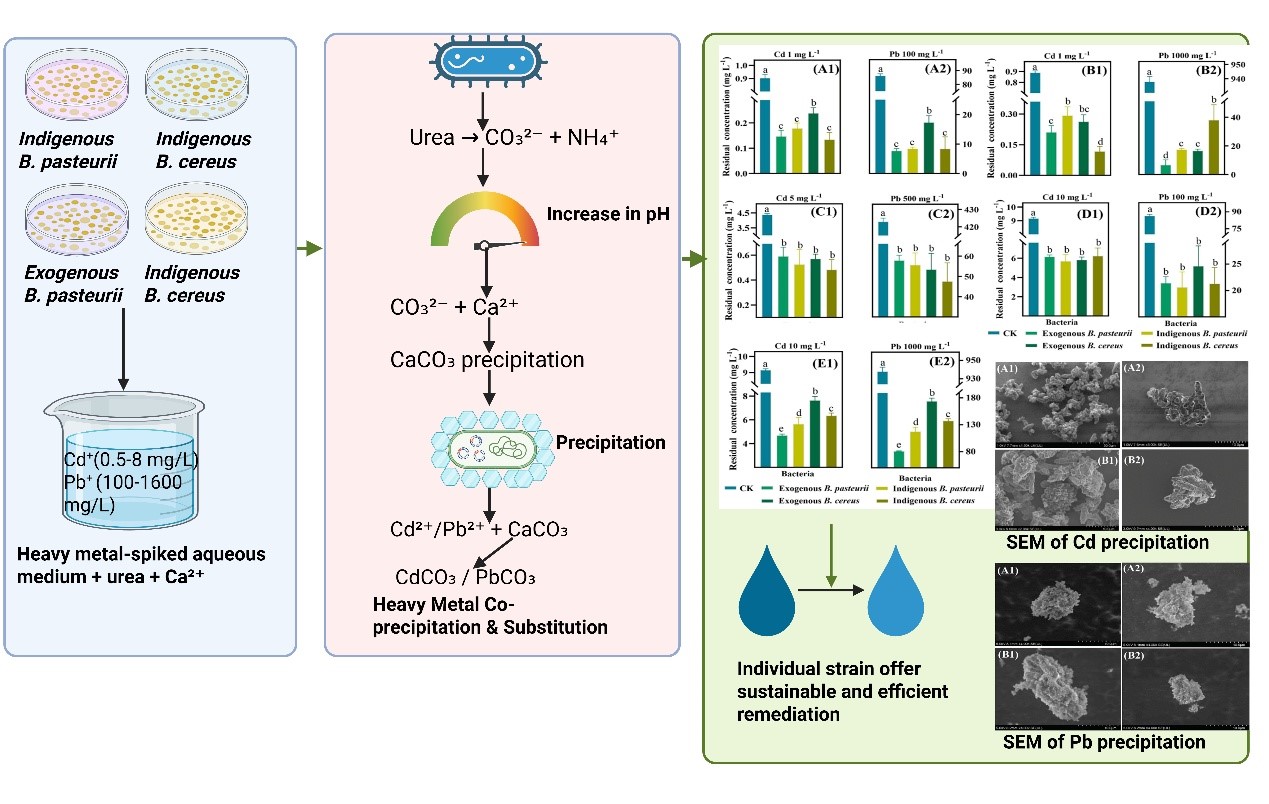
Mineralizing bacteria “capture” heavy metals in water through biomineralization. (Image by ZHUANG Ping et al)
<関連情報>
- https://english.cas.cn/newsroom/research_news/life/202510/t20251029_1095066.shtml
- https://www.sciencedirect.com/science/article/abs/pii/S0304389425031061
水溶液中のカドミウムと鉛の固定化における鉱化細菌の役割 The role of mineralization bacteria in the immobilization of cadmium and lead in aqueous solutions
Ismail Khan, Mimi Wang, Li Shang, Bi Zou, Yingwen Li, Yongxing Li, Zhe Lu, Lulu Zhang, Faming Wang, Abdul Rehman, Ping Zhuang
Journal of Hazardous Materials Available online: 25 October 2025
DOI:https://doi.org/10.1016/j.jhazmat.2025.140187
Highlights
- Indigenous Bacillus strains achieved > 98 % Cd and Pb immobilization at low concentrations.
- B. pasteurii maintained high Cd removal (96 %) under elevated contamination levels.
- Co-contaminated systems revealed metal-specific responses and performance decline for Cd.
- SEM-EDS confirmed carbonate-bound Cd and Pb precipitates formed via microbial activity.
- Indigenous strains offer efficient, eco-friendly solutions for heavy metal bioremediation.
Abstract
Heavy metal contamination represents a critical environmental threat, driving the need for sustainable remediation technologies. This study demonstrates the efficacy of microbial-induced carbonate precipitation (MICP) for immobilizing cadmium (Cd) and lead (Pb) in aqueous systems using both indigenous and exogenous strains of Bacillus pasteurii and Bacillus cereus. Urease-mediated hydrolysis of urea generated carbonate ions that reacted with Cd2 + and Pb2+ to form insoluble carbonates. Through controlled laboratory experiments, we systematically evaluated biomineralization performance across single and co-contamination scenarios. Our findings demonstrate high immobilization efficiencies. At low concentrations (0.5–4.0 mg L-1), all four tested strains achieved over 98 % Cd2+ biomineralization, with B. pasteurii maintaining 96 % efficiency even at 8 mg L-1. Similarly, Pb immobilization exceeded 98 % at concentrations of 100–200 mg L-1, but declined at higher concentrations. B. pasteurii showed the highest Pb tolerance, while B. cereus performed lowest, dropping slightly above 80 %. B. pasteurii’s Cd precipitation peaked later on day 7, whereas B. cereus peaked on day 3. In co-contaminated systems, competitive inhibition was evident: Cd2+ immobilization ranged from 67 % to 89 % and Pb2+ from 80 % to 99 % at low to medium concentrations, but efficiencies dropped sharply at higher loads to 17–49 % for Cd2+ and 71–91 % for Pb2+. Pb2+ generally dominated removal due to its higher binding affinity and precipitation as low-solubility carbonates, although elevated Cd2+ partially suppressed Pb²⁺ immobilization. Immobilization kinetics varied across strains, with native isolates initiating mineralization earlier and producing more structured, metal-rich precipitates as confirmed by SEM-EDS analysis. Overall, this study demonstrates the superior and stable performance of indigenous Bacillus strains and underscores the importance of microbial physiology, strain selection, and metal-metal interactions in shaping bioremediation outcomes, providing a strong basis for future field-scale validation and molecular-level investigations.