2025-11-17 成育医療研究センター
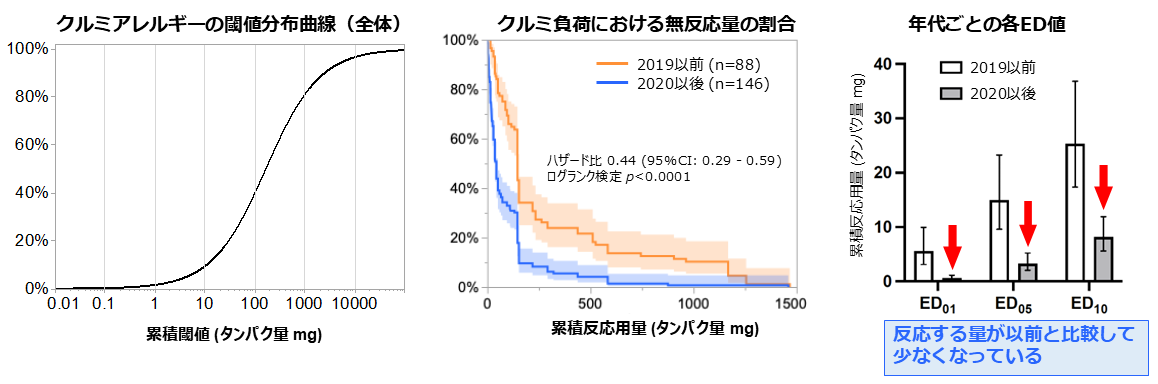
【図:クルミに対するアレルギー症状の出る量の検討】
<関連情報>
- https://www.ncchd.go.jp/press/2025/1117.html
- https://www.ncchd.go.jp/press/2025/1117.pdf
- https://www.sciencedirect.com/science/article/pii/S2772829325001833
日本におけるピーナッツおよび木の実アレルギーの有病率と誘発量の過去10年間の傾向 Trends over a decade in the prevalence and eliciting dose of peanut and tree nut allergies in Japan
Hitomi Kubota MD, Tatsuki Fukuie MD, PhD, Sayaka Hamaguchi MD, Seiko Hirai MD, Kenji Toyokuni MD, PhD, Kiwako Yamamoto-Hanada MD, PhD, Akira Ishiguro MD, PhD, Yukihiro Ohya MD, PhD
Journal of Allergy and Clinical Immunology: Global Available online: 8 October 2025
DOI:https://doi.org/10.1016/j.jacig.2025.100582
Background
The prevalence of tree nuts allergy is rapidly increasing in Japan, yet the eliciting dose (ED) for tree nuts, particularly in Asian populations, has not been sufficiently investigated.
Objective
This study aimed to quantify EDs for peanut, cashew nut, and walnut in Japanese patients with food allergies and to investigate longitudinal changes in these values.
Methods
We retrospectively analyzed 1,275 oral food challenge results for patients with diagnosed peanut, cashew nut, or walnut allergy, conducted between November 2013 and December 2023 at a single allergy center. EDs were calculated using the Weibull, log-normal, and log-logistic models, and bivariate survival analysis was used to examine the relationship between allergen-specific IgE levels and ED causing reaction in 5% of the allergic population (ED05).
Results
The ED05 values were determined as 4.88 mg for peanut, 0.53 mg for cashew nut, and 4.37 mg for walnut. When the component-specific IgE was set at 50.0 kUA/L, ED05 decreased to 3.20 mg, 0.55 mg, and 1.92 mg, respectively. Notably, a marked decline in walnut ED was observed over time.
Conclusions
EDs in Japanese tree nut–allergic populations are decreasingly aligned with those reported in Western countries, reflecting shifts in dietary habits and allergen exposure. The findings of the dynamic nature of threshold dose distributions over time, even within the same region, emphasize the necessity for periodic reassessment of allergen risk thresholds to ensure optimal patient safety.