2025-11-24 カリフォルニア大学アーバイン校(UCI)
<関連情報>
- https://news.uci.edu/2025/11/24/uc-irvine-led-study-finds-global-embrace-of-integrative-cancer-care/
- https://bmccomplementmedtherapies.biomedcentral.com/articles/10.1186/s12906-025-05157-6
症状管理のための統合腫瘍学的モダリティの評価:MASCC/SIOグローバル調査 Evaluation of integrative oncology modalities for symptom management: a MASCC/SIO global survey
Alexandre Chan,Reem Nasr,Daniela Arcos,Dalia Kagramanov,Chioma Asuzu,Ting Bao,Yin Ting Cheung,Jung Hye Kwon,Judith Lacey,Richard T. Lee,Maryam Lustberg,Beatrice M. Ohaeri,Santosh Rao,Enrique Soto-Perez-de-Celis,Claudia M. Witt & Ana Maria Lopez
BMC Complementary Medicine and Therapies Published:03 November 2025
DOI:https://doi.org/10.1186/s12906-025-05157-6
Abstract
Background
With growing evidence pointing towards the potential of integrative oncology modalities (IOM) in addressing cancer and cancer-treatment related symptoms, research on IOM utilization and implementation is warranted. This study examines global stakeholder perspectives on integrative oncology (IO) utilization for supportive cancer care.
Methods
Members of the Multinational Association of Supportive Care in Cancer (MASCC) and the Society for Integrative Oncology (SIO) completed a survey on the utilization of IOM for supportive cancer care. Descriptive statistics were used to assess demographic data, IOM usage patterns, IOM education, and financial considerations for utilizing IOM.
Results
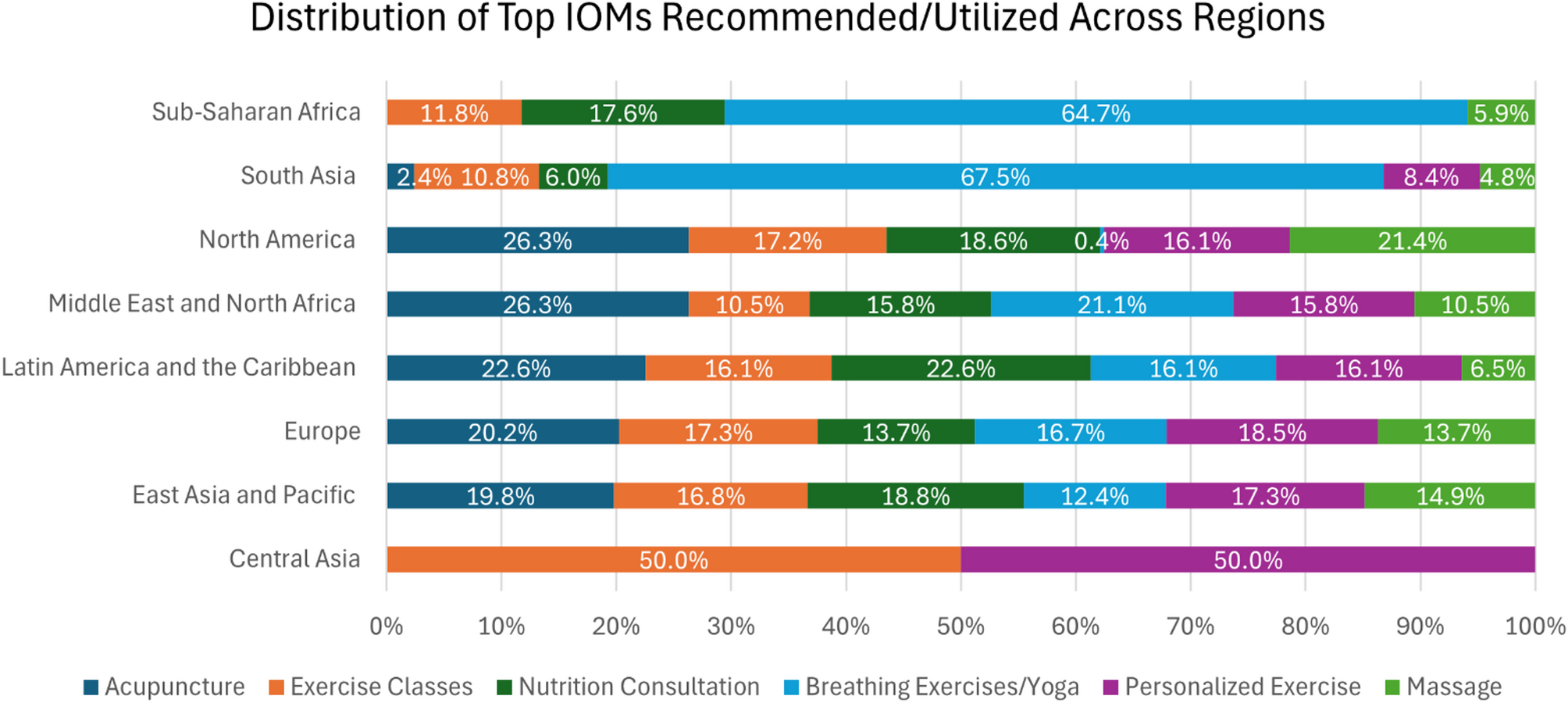
Among 344 participants representing eight geographical regions, 70% reported having utilized or recommended IOM and 79% perceived IOM to be underutilized in cancer supportive care. Acupuncture (48%), exercise classes (39%), nutrition (38%), breathing/yoga (38%) and personalized exercise (38%) were among the most utilized IOM across regions. Relatedly, the symptoms for which IOM were most recommended for persons with a diagnosis of cancer in active treatment [AT] or completed treatment [CT] respectively were emotional (AT 23%; CT 26%), pain (AT 22%; CT 20%), gastrointestinal (AT 21%; CT 12%) and fatigue (AT 15%; CT 16%). The perceived availability of integrative medicine training was highest in North America (69%). Across regions, self-pay (20%-67%), private insurance (0%-26%) and government insurance (7%-40%) were the most common forms of payment for IOM. The IOM most recommended in high-income countries (acupuncture, exercise, massage, individual exercise) varied from the IOM most recommended in low-middle income countries (nutrition counseling, exercise classes, breathing, acupuncture).
Conclusion
This study provides valuable insights into global utilization patterns of IOM in supportive cancer care, highlighting that while most respondents have utilized IOM, there is a perceived underutilization overall. Our results show significant regional differences in the availability of integrative oncology education and hint to financial barriers impacting IOM use. Further research is necessary to explore these aspects and inform strategies for supporting IOM implementation efforts.