2025-11-27 カロリンスカ研究所(KI)
<関連情報>
- https://news.ki.se/complications-after-stent-surgery-more-common-in-individuals-with-diabetes
- https://diabetesjournals.org/care/article-abstract/doi/10.2337/dc25-1624/163904/Coronary-Stent-Failure-in-Patients-With-Diabetes-A
糖尿病患者における冠動脈ステント留置不全:SWEDEHEARTによる全国観察研究 Coronary Stent Failure in Patients With Diabetes: A Nationwide Observational Study From SWEDEHEART
Irene Santos-Pardo;Mikael Andersson Franko;Robin Hofmann;Thomas Nyström
Diabetes Care Published:November 27 2025
DOI:https://doi.org/10.2337/dc25-1624
Graphical Abstract
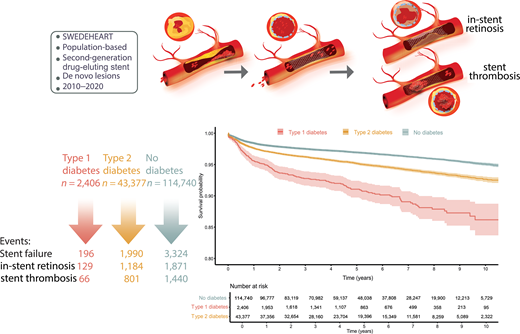
OBJECTIVE
The association between diabetes and coronary stent failure is poorly established with second-generation drug-eluting stents (DES). We aimed to evaluate the risk of stent failure in patients with diabetes compared with those without diabetes after implantation of second-generation DES.
RESEARCH DESIGN AND METHODS
All patients in Sweden who received second-generation DES between 2010 and 2020 were included and categorized into three groups: type 1 diabetes, type 2 diabetes, and without diabetes (reference group). The primary end point was stent failure, defined as in-stent restenosis or stent thrombosis. Adjusted hazard ratios (HRs) with 95% CIs were estimated by Cox regression models. Sensitivity analyses were performed to address missing data in covariates and account for death as a competing risk.
RESULTS
The study included 160,523 patients: 2,406 with type 1 diabetes, 43,377 with type 2 diabetes, and 114,740 without diabetes. Seventy-one percent were male. Over a mean follow-up of 4.5 years, 5,510 stent failure events occurred. The fully adjusted HR for stent failure was 2.28 (95% CI 1.97–2.65) for patients with type 1 and 1.35 (95% CI 1.27–1.44) for patients with type 2 diabetes, compared with individuals without diabetes. Sensitivity analyses confirmed the robustness of the findings, with both in-stent restenosis and stent thrombosis contributing to the increased risk.
CONCLUSIONS
We observed a significantly higher risk of second-generation DES stent failure in individuals with type 1 diabetes followed by those with type 2 diabetes, compared with individuals without diabetes. This elevated risk was attributed to both in-stent restenosis and stent thrombosis.