2026-01-02 ニューヨーク大学(NYU)
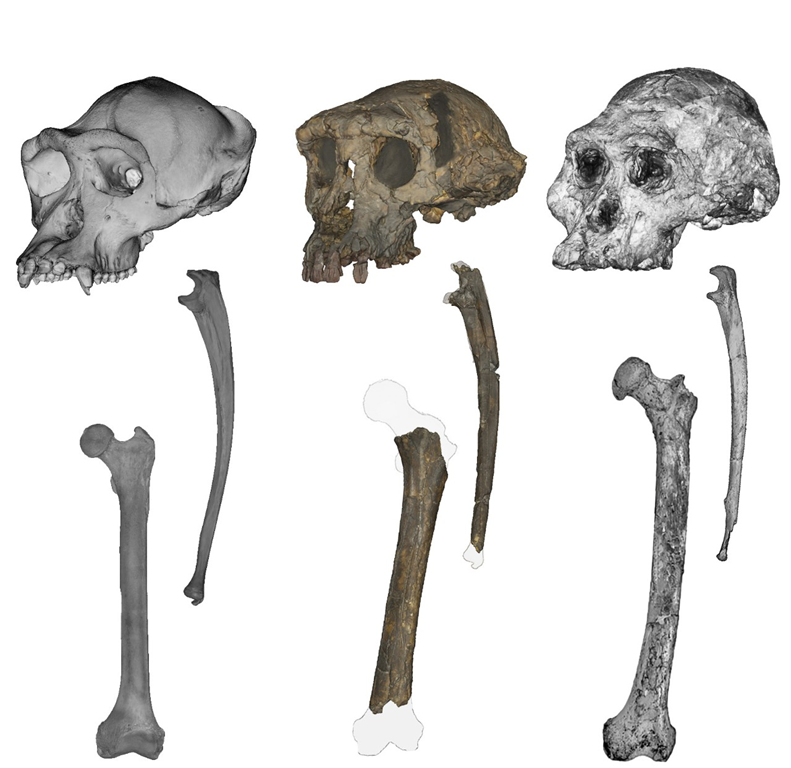
Crania, ulnae, and femora of (left to right): a chimpanzee, Sahelanthropus, and Australopithecus. Image courtesy of Scott Williams/NYU and Jason Heaton/University of Alabama Birmingham.
<関連情報>
- https://www.nyu.edu/about/news-publications/news/2026/january/anthropologists-offer-new-evidence-of-bipedalism-in-long-debated.html
- https://www.science.org/doi/10.1126/sciadv.adv0130
サヘラントロプス・チャデンシスにおける人類の二足歩行の最も古い証拠 Earliest evidence of hominin bipedalism in Sahelanthropus tchadensis
Scott A. Williams, Xue Wang, Isabella Araiza, Jordan S. Guerra, […] , and Jeffrey K. Spear
Science Advances Published:2 Jan 2026
DOI:https://doi.org/10.1126/sciadv.adv0130
Abstract
Bipedalism is a key adaptation that differentiates hominins (humans and our extinct relatives) from living and fossil apes. The earliest putative hominin, Sahelanthropus tchadensis (~7 million years old), was originally represented by a cranium, the reconstruction of which suggested to its discoverers that Sahelanthropus carried its head in a manner similar to known bipedal hominins. Recently, two partial ulnae and a femur shaft were announced as evidence in support of the contention that Sahelanthropus was an early biped, but those interpretations have been challenged. Here, while we find that both limb bones are most similar in size and geometric morphometric shape to chimpanzees (genus Pan), we demonstrate that their relative proportion is more hominin-like. Furthermore, we confirm two features linked to hominin-like hip and knee function and identify a femoral tubercle, a feature only found in bipedal hominins. Our results suggest that Sahelanthropus was an early biped that evolved from a Pan-like Miocene ape ancestor.