2026-05-11 東京科学大学
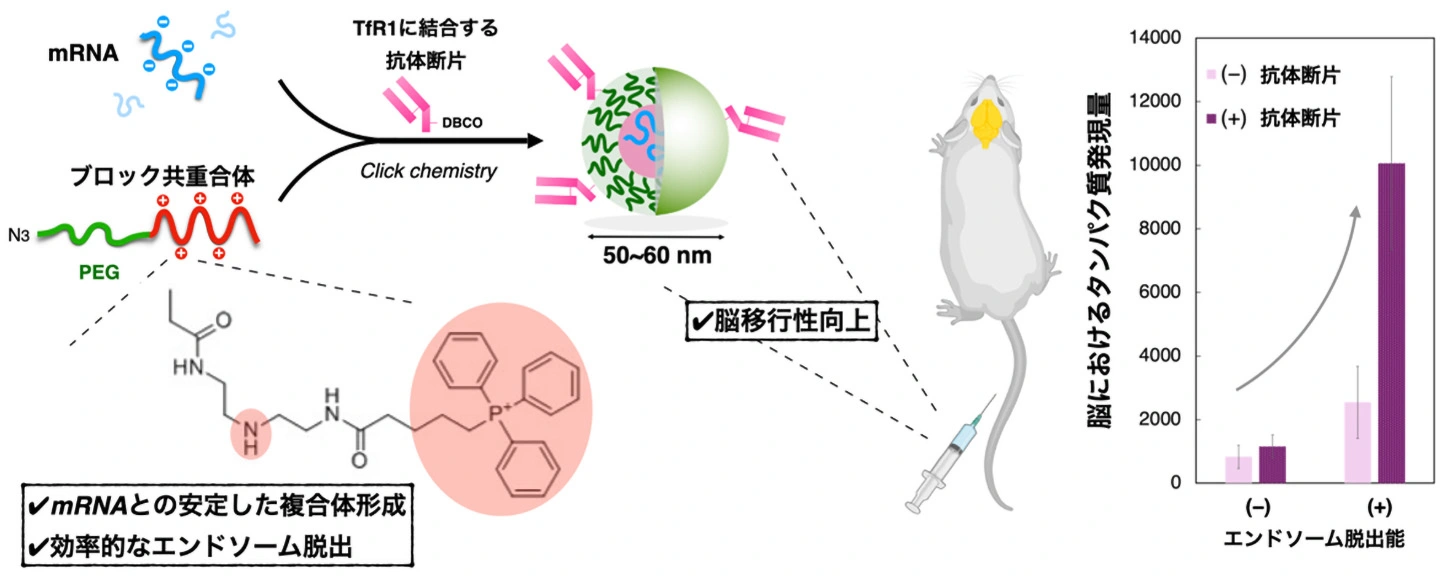
図1. 本研究の概要
<関連情報>
- https://www.isct.ac.jp/ja/news/q68fk9h45pnr
- https://pubs.acs.org/doi/10.1021/acs.molpharmaceut.5c01925
トランスフェリン受容体1を標的とするイオン化可能な高分子ミセルは、脳への全身性mRNA送達を促進する Ionizable Polymeric Micelles Targeting Transferrin Receptor 1 Enhance Systemic mRNA Delivery to the Brain
Jumpei Norimatsu,Hayato L. Mizuno,Yuki Mochida,Shigeto Fukushima,Satoshi Uchida,Horacio Cabral,and Yasutaka Anraku
Molecular Pharmaceutics Published: April 13, 2026
DOI:https://doi.org/10.1021/acs.molpharmaceut.5c01925
Abstract
mRNA-based therapies hold immense potential for treating a plethora of diseases. However, their application to central nervous system (CNS) disorders remains limited due to biological barriers, such as rapid degradation in circulation, restricted brain access, and endosomal entrapment within cells. To address these challenges, we developed a polymeric micelle-based nanocarrier capable of systemically delivering mRNA to the brain. This system employed triphenylphosphonium (TPP) as a cationic moiety to stably complex with mRNA and prolong its blood circulation. TPP was introduced into a PEG–polyaspartamide derivative bearing diethylenetriamines, whose pH-responsive ionizable amines facilitated endosomal escape. For brain targeting, antibody fragments against transferrin receptor 1 were conjugated to the PEG shell at a controlled density via click chemistry. This rational, multifaceted design enabled robust in situ protein production in the brain following systemic administration, achieving around a 10-fold increase compared to our initial formulation, while exerting lower impact on off-target expression in other organs. Our system offers a promising platform for systemic mRNA delivery to the brain, opening new avenues for treating CNS disorders.