2026-02-03 エディンバラ大学
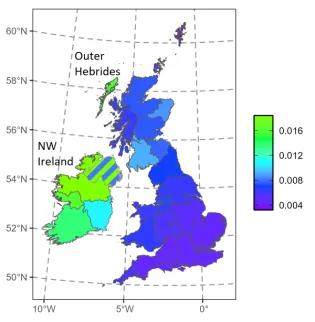
Map of the landscape of hereditary haemochromatosis risk across the UK and Ireland. Areas with a higher frequency of the disease-causing C282Y genetic variant are indicated in green. Hatching is used to represent two communities in Northern Ireland, each with different risks.
<関連情報>
- https://www.ed.ac.uk/news/celtic-curse-genetic-disease-hotspots-revealed
- https://www.nature.com/articles/s41467-025-65511-7
イギリス諸島とアイルランドにおける遺伝性ヘモクロマトーシスのリスクと診断の状況 The landscape of hereditary haemochromatosis risk and diagnosis across the British Isles and Ireland
Shona M. Kerr,Benjamin S. Fletcher,Gannie Tzoneva,Alan R. Shuldiner,Edmund Gilbert & James F. Wilson
Nature Communications Published:03 February 2026
DOI:https://doi.org/10.1038/s41467-025-65511-7
Abstract
Hereditary haemochromatosis is caused by pathogenic variants in the homoeostatic iron regulator gene HFE. Outcomes include liver cancer, cirrhosis and arthropathy, but penetrance is incomplete. Here, we use genetic data from >400,000 subjects to determine the genetic risk across 29 regions of the British Isles and Ireland. Northwest Irish and Outer Hebrideans are at the highest risk (1/54 – 1/62 carry the major risk genotype), Mainland Scots are also at increased risk (1/117), declining to 1/212 in Southern England. We also assessed the prevalence of clinically diagnosed haemochromatosis in >63 million people in NHS England and identified 70,365 cases. White Irish individuals have the highest prevalence (3.7x white British). Among white British, prevalence varied 11-fold from 1/1972 in parts of Kent to 1/177 in Liverpool. Discrepancies between genetic risks and prevalences of clinical diagnoses for Birmingham, Cumbria, Northumberland and Durham suggest under-diagnosis in these regions. We show heightened genetic risk of haemochromatosis in people of Northwest Irish and Hebridean ancestry and suggest health-economic modelling of community screening should be targeted to these priority areas.