2026-02-10 東北大学
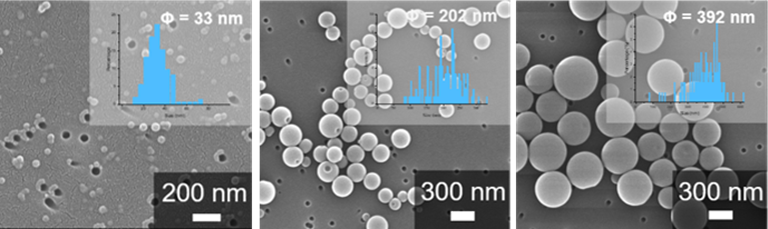
図1. 異なるサイズで作製したナノ・プロドラッグのSEM像
<関連情報>
- https://www.tohoku.ac.jp/japanese/2026/02/press20260210-01-nano.html
- https://www.tohoku.ac.jp/japanese/newimg/pressimg/tohokuuniv-press20260210_01web_nano.pdf
- https://pubs.rsc.org/en/content/articlelanding/2026/pm/d5pm00364d
サイズ工学によるキャリアフリーナノプロドラッグ による膵臓がんの間質バリアの克服 Overcoming stromal barriers in pancreatic cancer via size-engineered carrier-free nano-prodrugs
Mengheng Yang,Ryuju Suzuki,Yoshitaka Koseki,Shuto Kodera,Ken Saijo,Hisato Kawakami,Keita Tanita,Sanjay Kumar,Kouki Oka and Hitoshi Kasai
RSC Pharmaceutics Published:30 Jan 2026
DOI:https://doi.org/10.1039/D5PM00364D
Abstract
Pancreatic cancer remains a major therapeutic challenge due to its dense desmoplastic stroma, which limits drug penetration and reduces chemotherapy efficacy. Here, we report a carrier-free nanoprodrug (CFNPG) based on SNC4DC, a homodimeric prodrug of SN-38, enabling controlled SN-38 release in pancreatic cancer cells. Using a precisely controlled reprecipitation method, we generated stable CFNPGs with tunable particle sizes down to ∼30 nm, resulting in enhanced tissue penetration. These nanoparticles exhibited high drug loading, absence of carrier-associated toxicity, potent antitumor activity, and minimal systemic side effects in an orthotopic pancreatic cancer model, providing a physiologically relevant assessment of drug delivery. Our findings demonstrate that precise size engineering of carrier-free nanoprodrugs can significantly improve tissue penetration and therapeutic efficacy, providing a clinically translatable strategy for pancreatic cancer therapy.