2026-03-04 アメリカ国立衛生研究所(NIH)
<関連情報>
- https://www.nih.gov/news-events/news-releases/automated-ct-scan-analysis-could-fast-track-clinical-assessments
- https://www.nature.com/articles/s41586-026-10181-8
Merlin: コンピュータ断層撮影による視覚言語基盤モデルとデータセット Merlin: a computed tomography vision–language foundation model and dataset
Louis Blankemeier,Ashwin Kumar,Joseph Paul Cohen,Jiaming Liu,Longchao Liu,Dave Van Veen,Syed Jamal Safdar Gardezi,Hongkun Yu,Magdalini Paschali,Zhihong Chen,Jean-Benoit Delbrouck,Eduardo Reis,Robbie Holland,Cesar Truyts,Christian Bluethgen,Yufu Wu,Long Lian,Malte Engmann Kjeldskov Jensen,Sophie Ostmeier,Maya Varma,Jeya Maria Jose Valanarasu,Zhongnan Fang,Zepeng Huo,Zaid Nabulsi,… Akshay S. Chaudhari
Nature Published:04 March 2026
DOI:https://doi.org/10.1038/s41586-026-10181-8
Abstract
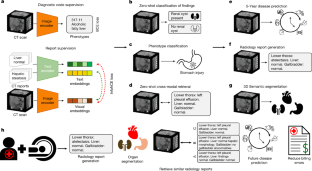
The large volume of abdominal computed tomography (CT) scans1,2 coupled with the shortage of radiologists3,4,5,6 have intensified the need for automated medical image analysis tools. Previous state-of-the-art approaches for automated analysis leverage vision–language models (VLMs) that jointly model images and radiology reports7,8,9,10,11,12. However, current medical VLMs are generally limited to 2D images and short reports. Here to overcome these shortcomings for abdominal CT interpretation, we introduce Merlin, a 3D VLM that learns from volumetric CT scans, electronic health record data and radiology reports. This approach is enabled by a multistage pretraining framework that does not require additional manual annotations. We trained Merlin using a high-quality clinical dataset of paired CT scans (>6 million images from 15,331 CT scans), diagnosis codes (>1.8 million codes) and radiology reports (>6 million tokens). We comprehensively evaluated Merlin on 6 task types and 752 individual tasks that covered diagnostic, prognostic and quality-related tasks. The non-adapted (off-the-shelf) tasks included zero-shot classification of findings (30 findings), phenotype classification (692 phenotypes) and zero-shot cross-modal retrieval (image-to-findings and image-to-impression). The model-adapted tasks included 5-year chronic disease prediction (6 diseases), radiology report generation and 3D semantic segmentation (20 organs). We validated Merlin at scale, with internal testing on 5,137 CT scans and external testing on 44,098 CT scans from 3 independent sites and 2 public datasets. The results demonstrated high generalization across institutions and anatomies. Merlin outperformed 2D VLMs, CT foundation models and off-the-shelf radiology models. We also computed scaling laws and conducted ablation studies to identify optimal training strategies. We release our trained models, code and dataset for 25,494 pairs of abdominal CT scans and radiology reports. Our results demonstrate how Merlin may assist in the interpretation of abdominal CT scans and mitigate the burden on radiologists while simultaneously adding value for future biomarker discovery and disease risk stratification.