2026-05-25 東京大学
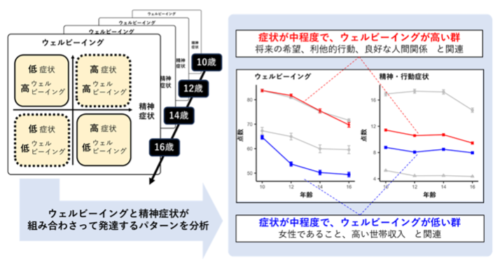
同程度の精神症状であっても、ウェルビーイングが高い群と低い群が存在することを解明 思春期におけるウェルビーイングと精神症状が組み合わさって発達するパターンを分析した
<関連情報>
- https://www.h.u-tokyo.ac.jp/press/20260525.html
- https://www.h.u-tokyo.ac.jp/press/__icsFiles/afieldfile/2026/05/25/release_20260525.pdf
- https://www.cambridge.org/core/journals/psychological-medicine/article/patterns-of-subjective-wellbeing-and-psychopathology-trajectories-in-adolescence-a-populationbased-cohort-study/3C05C841A4E97EEDBE31687C9EDA0264
青年期における主観的幸福感と精神病理の軌跡のパターン:集団ベースのコホート研究 Patterns of subjective well-being and psychopathology trajectories in adolescence: a population-based cohort study
Akito Uno,Daiki Nagaoka,Rin Minami,Riki Tanaka,Yutaka Sawai,Ayako Okuma,Nanami Tomoshige,Satoshi Yamaguchi,Syudo Yamasaki and Mitsuhiro Miyashita,…
Psychological Medicine Published:25 May 2026
DOI:https://doi.org/10.1017/S0033291726104243
Abstract
Background
Mental health encompasses subjective well-being (SWB) as well as psychopathology (PP). SWB and PP are related but separate domains: some individuals experience high SWB despite high PP, and others experience low SWB despite minimal PP. Given substantial and heterogeneous developmental changes in both domains during adolescence, examining their co-developmental trajectories may clarify how they integrate across this period.
Methods
Using data from the Tokyo Teen Cohort (N = 2994), a population-based prospective birth cohort study, we conducted parallel process latent class growth analysis to cluster SWB–PP trajectories at ages 10, 12, 14, and 16 years. We then investigated various sociodemographic, individual, familial, and socioenvironmental correlates for each class.
Results
We identified four distinct classes: high SWB–low PP (55.0%), high SWB–mid PP (20.2%), low SWB–mid PP (17.0%), and mid SWB–high PP (7.7%). SWB declined from ages 10 to 16 years across all four classes. Lower PP did not necessarily correspond to higher SWB, and in some pairs of classes, the relationship between SWB and PP levels was reversed. When comparing the two classes with moderate PP, higher aspirations, more prosocial behavior, and better interpersonal relationships were associated with the high SWB class. In contrast, being female and having a higher household income were associated with the low SWB class.
Conclusions
Discrepant SWB–PP trajectories suggest characteristic patterns of developmental integration between these domains during adolescence. Considering their interplay may complement domain-specific approaches and inform psychosocial supports aimed at maintaining SWB even in the presence of PP.