2026-03-24 東北大学
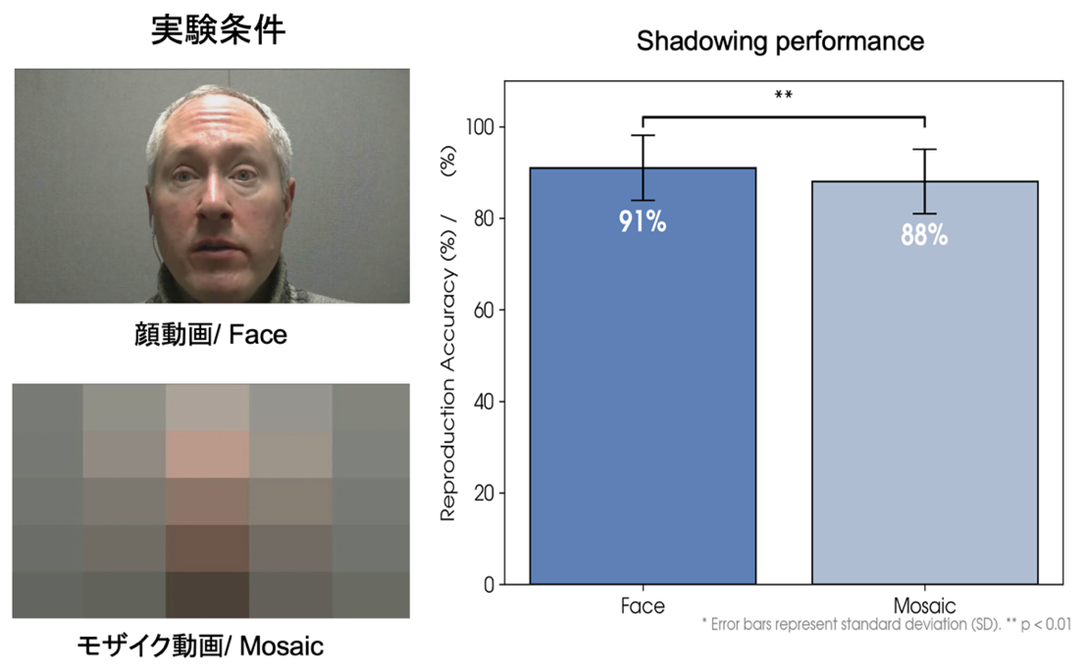
図1. 顔が見えるとシャドーイングの再現精度が向上
<関連情報>
- https://www.tohoku.ac.jp/japanese/2026/03/press20260324-03-shadowing.html
- https://www.tohoku.ac.jp/japanese/newimg/pressimg/tohokuuniv-press20260324_03_shadowing.pdf
- https://onlinelibrary.wiley.com/doi/10.1111/lang.70026
話者の顔を見ることで第二言語のシャドーイングが強化される:神経学的および行動学的証拠 Seeing the Speaker’s Face Enhances Second Language Shadowing: Neural and Behavioral Evidence
Hyeonjeong Jeong, Shuhei Kadota, Mayumi Kajiura, Hiroshi Nakanishi, Koji Kazai, Mariko Kawasaki, Yoko Nakano, Naoya Hase
Language Learning Published: 12 March 2026
DOI:https://doi.org/10.1111/lang.70026
Abstract
This functional magnetic resonance imaging (fMRI) study investigated how facial cues influence second language (L2) shadowing among 42 Japanese learners of English. Participants completed four conditions that varied by task type (listening vs. shadowing) and visual input (face vs. mosaic). Behaviorally, shadowing reproduction accuracy was higher when the speaker’s face was visible. Neuroimaging revealed greater activation in the left posterior middle temporal gyrus (pMTG), right ventral pallidum, and left hippocampus during shadowing in the Face condition, reflecting enhanced audiovisual integration, engagement, and memory-related processing. Learners with higher oral proficiency exhibited increased activation in speech-integration areas, such as the posterior superior temporal gyrus, and those with higher listening proficiency showed reduced cerebellar engagement, suggesting proficiency-dependent neural strategies for integrating facial cues during shadowing. These findings support embodied, multisensory, and socially grounded accounts of L2 learning, emphasizing the pedagogical importance of visible facial cues. Incorporating face-based shadowing into L2 learning may help bridge perception and production and prepare learners for interaction-oriented communication.