2026-03-25 東京科学大学
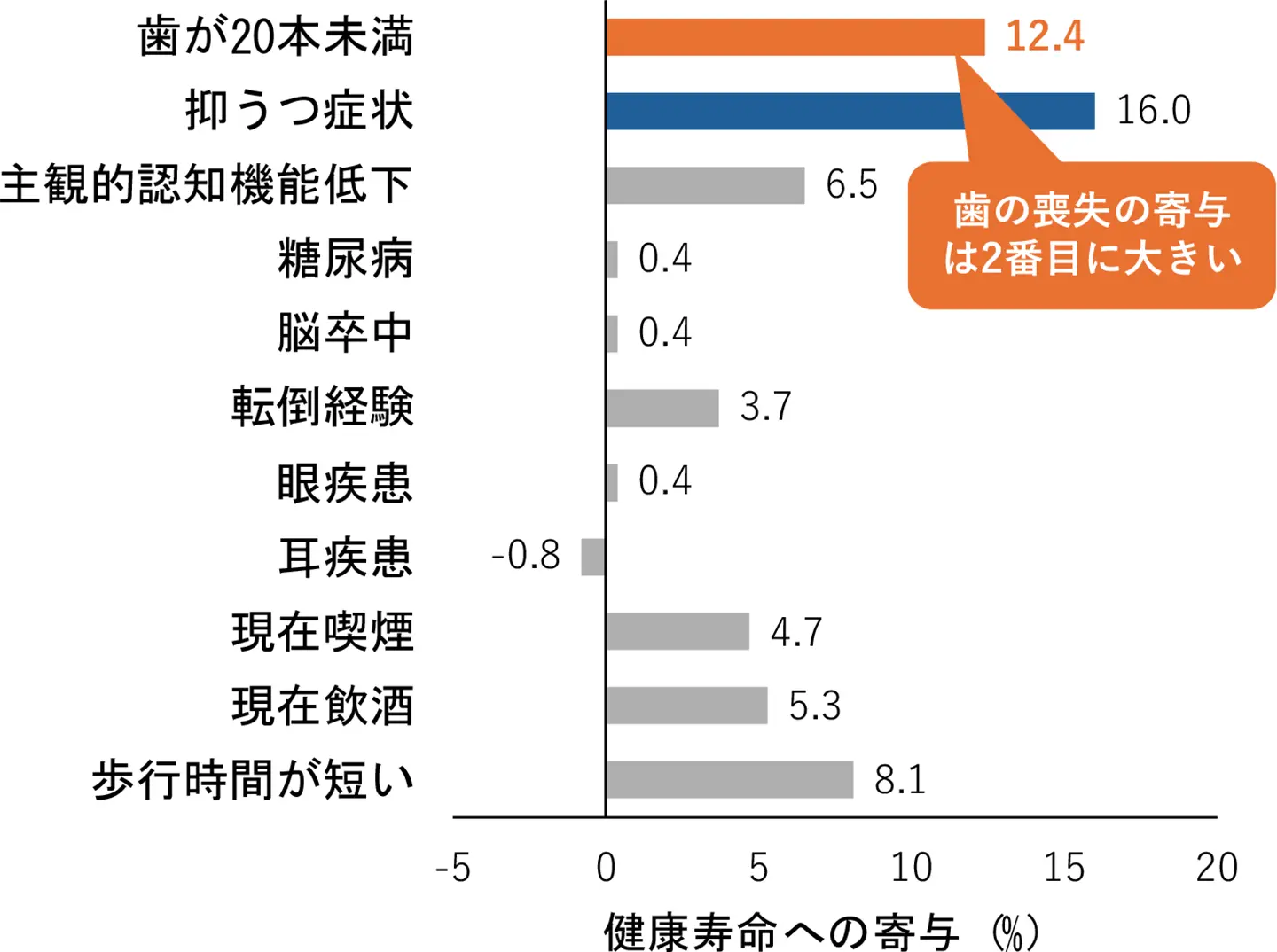
図1. 死亡および要介護の健康格差に対する各リスク因子の寄与。n = 48,474。
<関連情報>
- https://www.isct.ac.jp/ja/news/pqdszwlpiv11
- https://journals.sagepub.com/doi/10.1177/00220345251414360
- https://www.jstage.jst.go.jp/article/jea/advpub/0/advpub_JE20250127/_article
歯の喪失が死亡率に及ぼす高次元効果の異質性 High-Dimensional Effect Heterogeneity of Tooth Loss on Mortality
Y. Matsuyama, S. Kiuchi, […], and J. Aida
Journal of Dental Research Published:March 15, 2026
DOI:https://doi.org/10.1177/00220345251414360
Abstract
Tooth loss has been associated with increased mortality risk in older adults. This study examined heterogeneity in the association between tooth loss and mortality among older Japanese adults. Data were obtained from 69,265 individuals aged ≥65 y who participated in the 2013 wave of the Japan Gerontological Evaluation Study. Questionnaire survey responses were linked to mortality records from municipal registries for 9 y. The average treatment effect (ATE) of tooth loss (having <20 natural teeth) on all-cause mortality was estimated using a linear probability model with an inverse probability weighting estimator. Heterogeneity in the association was assessed by estimating conditional average treatment effects (CATEs) using the causal forest machine learning algorithm. A set of 44 covariates, including demographic, economic, social, health, and community-related factors, was incorporated as potential drivers of heterogeneity. During the follow-up period, 26.4% of participants with <20 teeth and 14.4% of those with ≥20 teeth died. Tooth loss was significantly associated with increased mortality risk by 3.2 percentage points after adjustment for covariates (average treatment effect = 0.032; 95% confidence interval, 0.023–0.040). A statistically significant heterogeneity in the estimated effects was observed (median CATE = 0.028; interquartile range = 0.010). Greater effects were identified among subgroups characterized by men, poor health status, and lower socioeconomic conditions. Heart disease, sex, and depression were the most influential contributors to this heterogeneity. Tooth loss was associated with mortality risk, with significant variation in the magnitude across population subgroups. Tooth loss may serve as an informative indicator of elevated mortality risk among older adults, particularly among vulnerable subgroups.
歯の喪失と障害および死亡率における社会経済的不平等:日本における大規模前向きコホート研究 Tooth loss and socioeconomic inequalities in disability and mortality: a large-scale prospective cohort study in Japan
Yusuke Matsuyama, Richard G Watt, Jun Aida
Journal of Epidemiology Published:January 10, 2026
DOI:https://doi.org/10.2188/jea.JE20250127
Abstract
Background: Socioeconomic inequalities in disability-free life span have been widening. We evaluated the mediating role of multiple modifiable risk factors, including tooth loss, on socioeconomic inequalities in disability onset and mortality among Japanese older adults.
Methods: This prospective cohort study utilised data from the Japan Gerontological Evaluation Study, targeting adults aged ≥65 years. The 2013 baseline questionnaire survey participants were followed until 2022 (n = 48,474; median follow-up 9.0 years). Time-varying mediators were also assessed in questionnaire surveys in 2016 and 2019. Discrete-time survival analysis estimated the association of socioeconomic status (SES) –a standardised principal component score incorporating household income, wealth, and years of education—with disability or mortality onset. The Karlson–Holm–Breen method decomposed total effects into pathways through 11 mediators, including tooth loss and major risk factors for disability and mortality.
Results: During the follow-up, 29.1% became disabled or died. Compared to the highest SES group, the lowest SES quartile group exhibited hazard ratios (95% confidence intervals [CI]) of 1.26 (1.19, 1.34) for disability or mortality. Tooth loss exhibited the second largest indirect effect (proportion mediated [95% CI], 12.4% [8.0, 17.2]), following moderate depression (16.0% [11.7, 21.5]). Tooth loss exhibited the strongest association with SES, attributing to the large indirect effect.
Conclusion: The findings suggest that tackling inequalities in tooth loss may be an effective way to reduce socioeconomic inequalities in a disability-free life span.