2026-03-25 京都大学iPS細胞研究所
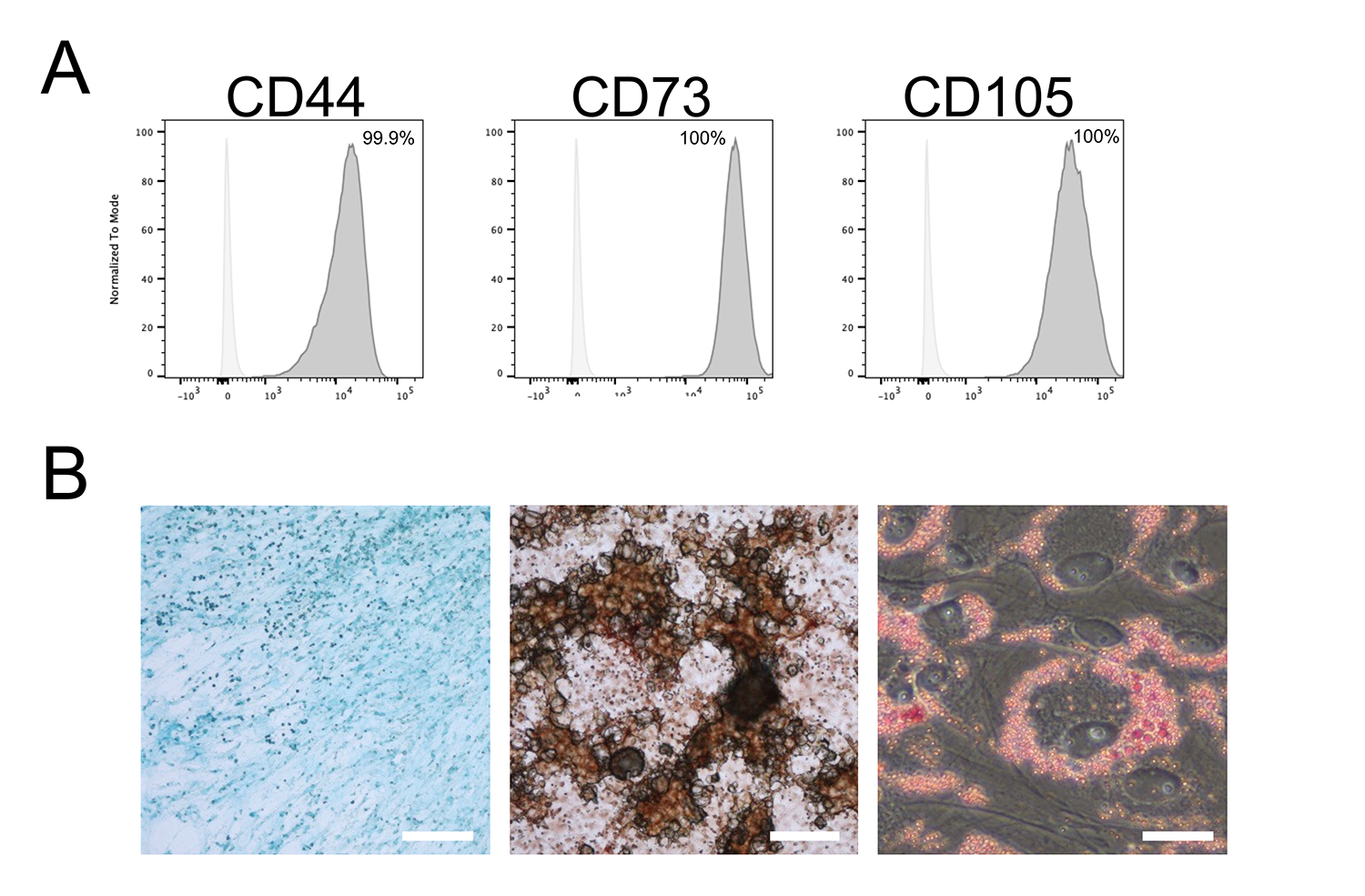
図1. XF-iMSCの特性評価
<関連情報>
- https://www.cira.kyoto-u.ac.jp/j/pressrelease/news/260325-100000.html
- https://www.sciencedirect.com/science/article/pii/S2352320426000222
ヒト人工多能性幹細胞由来間葉系幹細胞/間質細胞およびその細胞外小胞の抗炎症作用および免疫調節作用 Anti-inflammatory and immunomodulatory effects of human induced pluripotent stem cells-derived mesenchymal stem/stromal cells and their extracellular vesicles
Yusaku Komoike, Daisuke Kamiya, Haruka Sasaki-Ban, Atsushi Matsuda, Hirokazu Matsumoto, Makoto Ikeya
Regenerative Therapy Available online: 26 February 2026
DOI:https://doi.org/10.1016/j.reth.2026.101081
Abstract
Introduction
Mesenchymal stem/stromal cells (MSCs) are multipotent cells that secrete multiple factors for tissue regeneration. These tissue-derived MSCs can self-renew, but their numbers are limited and decrease with age. The previously established xeno-free MSCs (XF-iMSCs), derived from human induced pluripotent stem cells (hiPSCs) of the neural crest cell (NCC) lineage, can regenerate damaged bone and skeletal muscle. However, the anti-inflammatory and immunomodulatory effects of XF-iMSCs have not been elucidated. Here, we aimed to elucidate the effects of XF-iMSCs and their extracellular vesicles (XF-iEv) on inflammation and immunomodulation.
Methods
XF-iMSCs were generated from hiPSCs using NCCs. Mouse PBMCs and splenocytes were obtained from male C57BL/6 mice. The MSCs were characterized using flow cytometry. Cytokine secretion stimulated by lipopolysaccharides (LPS) or Dynabeads CD3/CD28 was measured by ELISA. The proliferation of CellTrace Violet-labeled effector T cells (Teff) cultured with MSCs or their EVs was analyzed using a suppression assay. EVs were purified from the MSC culture medium using a MagCapture Exosome Isolation Kit. Proteome analysis of the EVs was performed using non-labeled liquid chromatography-tandem mass spectrometry.
Results
XF-iMSCs expressed representative MSC cell surface markers, including CD44, CD73, and CD105, but not CD45 or HLA-DR. XF-iMSCs and human adipocyte-derived MSCs (hAC-MSCs) suppressed LPS-stimulated IL-6 and TNF-α secretion in mouse PBMCs. Suppression of LPS-induced IL-6 and TNF-α secretion by XF-iEv and hAC-MSCs (hAC-Ev) was concentration-dependent. Fifty times-concentrated EVs from both XF-iMSCs and hAC-MSCs strongly suppressed IL-2, IFN-γ, and IL-17 secretion induced by dynabeads CD3/CD28 in mouse splenocytes. The effect of XF-iMSCs against inflammatory and anti-inflammatory cytokine production induced by LPS in hPBMCs was comparable to that of primary human adipocytes, bone marrow, and umbilical cord-derived MSCs. XF-iEv (x50) strongly inhibited TNF-α secretion from LPS-stimulated human PBMCs, although there was no effect on IL-6 secretion. Condition medium (CM) from XF-iMSCs promoted IL-10 secretion but not concentrated XF-iEv (x50). XF-iMSCs suppressed Teff proliferation to a level comparable to that of hAC-MSCs. XF-iEv had 1217 proteins with unique components compared to hAC-Ev.
Conclusions
XF-iMSCs and their EVs exert anti-inflammatory and immunomodulatory effects in human and mouse cell-based assays and have promising therapeutic applications for autoimmune diseases.