2026-04-21 京都大学
作成:古賀千絵
<関連情報>
- https://www.kyoto-u.ac.jp/ja/research-news/2026-04-21-2
- https://www.kyoto-u.ac.jp/sites/default/files/2026-04/web_2604_Koga-873fb0249a91e5714f7dd8088682b7cc.pdf
世代間暴力と高齢者虐待における、幼少期の肯定的な経験の役割 The Role of Positive Childhood Experiences in Intergenerational Violence and Elder Abuse
Chie Koga, Taishi Tsuji, […], and Takahiro Tabuchi
Journal of Interpersonal Violence Published:April 17, 2026
DOI:https://doi.org/10.1177/08862605261437087
Abstract
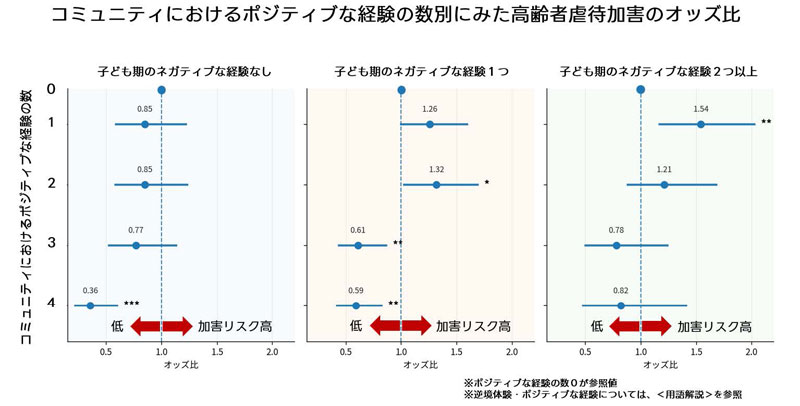
A previous study revealed that individuals with a high number of adverse childhood experiences (ACEs) have an increased risk of perpetrating physical and psychological abuse against older adults (≥65 years). However, whether two types of positive childhood experiences (PCEs) can buffer this association remains unclear. This study aimed to investigate whether PCEs provide a compensatory buffer against the association between ACEs and elder abuse perpetration. This cross-sectional study used data from the Japan COVID-19 and Society Internet Survey, conducted from September 12 to October 19, 2022. Participants included men and women aged 20 to 64 years who answered relevant survey questions. ACEs were defined as seven experiences before age 18: interpersonal loss (parental death or divorce), family psychopathology (parental mental illness or family violence), abuse (physical or psychological), and neglect. Community PCEs (CPCEs) and family PCEs were measured using a standardized scale. The primary outcome was self-reported perpetration of physical or psychological abuse against an older adult (≥65 years). Among 13,318 participants (mean [SD] age, 41.1 [12.1] years; 49.8% female), 1,133 (8.5%) reported perpetrating elder abuse. Among those with no ACEs, participants with a CPCE score of 4 had significantly lower odds of abuse compared to those with a score of 0 (OR = 0.36, 95% CI [0.209, 0.610]). This protective association weakened with higher ACE exposure. PCEs may compensate for the intergenerational transmission of violence, though important caveats remain.