
2026-05-06 アメリカ国立衛生研究所(NIH)
<関連情報>
- https://www.nih.gov/news-events/news-releases/oral-small-molecule-glp-1-drugs-penetrate-deep-into-brain-suppress-cravings
- https://www.nature.com/articles/s41586-026-10444-4
次世代減量薬によってマウスの脳報酬回路が阻害される A brain reward circuit inhibited by next-generation weight-loss drugs in mice
Elizabeth N. Godschall,,Taha Bugra Gungul,Isabelle R. Sajonia,Aleyna K. Buyukaksakal,Orien Li,Sophia Ogilvie,Austin B. Keeler,Guilian Tian,Yu Shi,Omar Koita,Chloe Xinzhu Guo,Tyler C. J. Deutsch,Eric J. Steacy,Maisie Crook,YuChen Zhang,Nicholas J. Conley,Gulsun Memi,Addison N. Webster,O. Yipkin Calhan,Weile Liu,Amani Akkoub,Karan Malik,Kaleigh I. West,Sara Michel-Le,… Ali D. Güler
Nature Published:06 May 2026
DOI:https://doi.org/10.1038/s41586-026-10444-4
Abstract
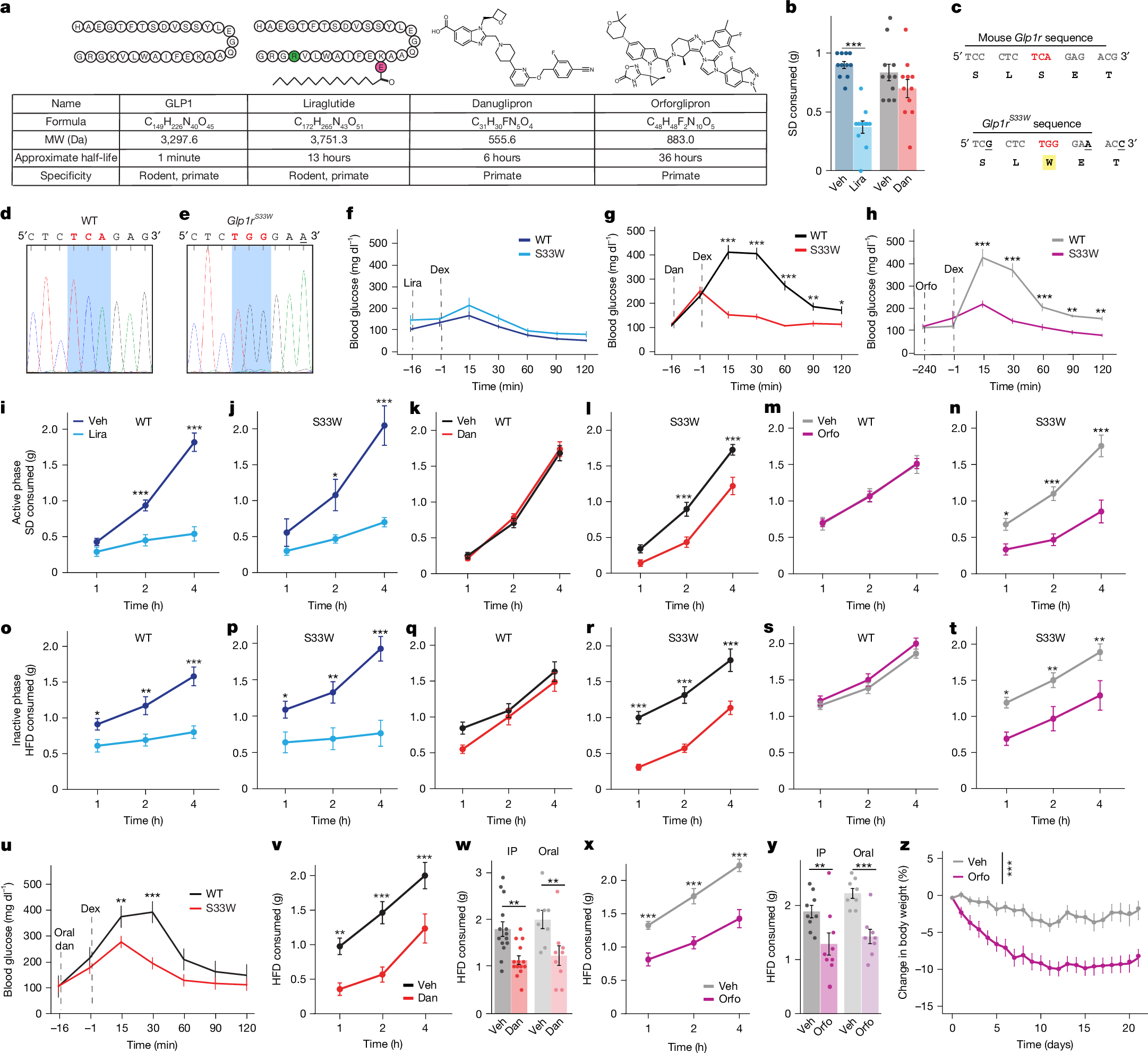
Glucagon-like peptide 1 receptor agonists (GLP1RAs) effectively reduce body weight and improve metabolic outcomes; however, established peptide-based therapies require injections and are complex to manufacture1,2,3. Small-molecule GLP1RAs promise oral bioavailability and scalable manufacturing, but their selective binding to human versus rodent receptors has limited mechanistic studies4,5,6,7,8,9. Here we developed humanized GLP1R mouse models to investigate how small-molecule GLP1RAs influence feeding behaviour. We found that these compounds regulate both homeostatic and hedonic feeding through parallel neural circuits. Beyond engaging canonical hypothalamic and hindbrain networks that control metabolic homeostasis, GLP1RAs recruit a discrete population of Glp1r-expressing neurons in the central amygdala, which selectively suppress the consumption of palatable foods by reducing dopamine release in the nucleus accumbens. Stimulating these central amygdalar neurons curtails hedonic feeding, whereas targeted deletion of the receptor in this cell population specifically diminishes the anorectic efficacy of GLP1RAs for reward-driven intake. These findings identify a neural circuit through which small-molecule GLP1RAs modulate reward processing, with implications for the treatment of substance-use disorder and binge eating.

