2026-05-11 合肥物質科学研究院(HFIPS)
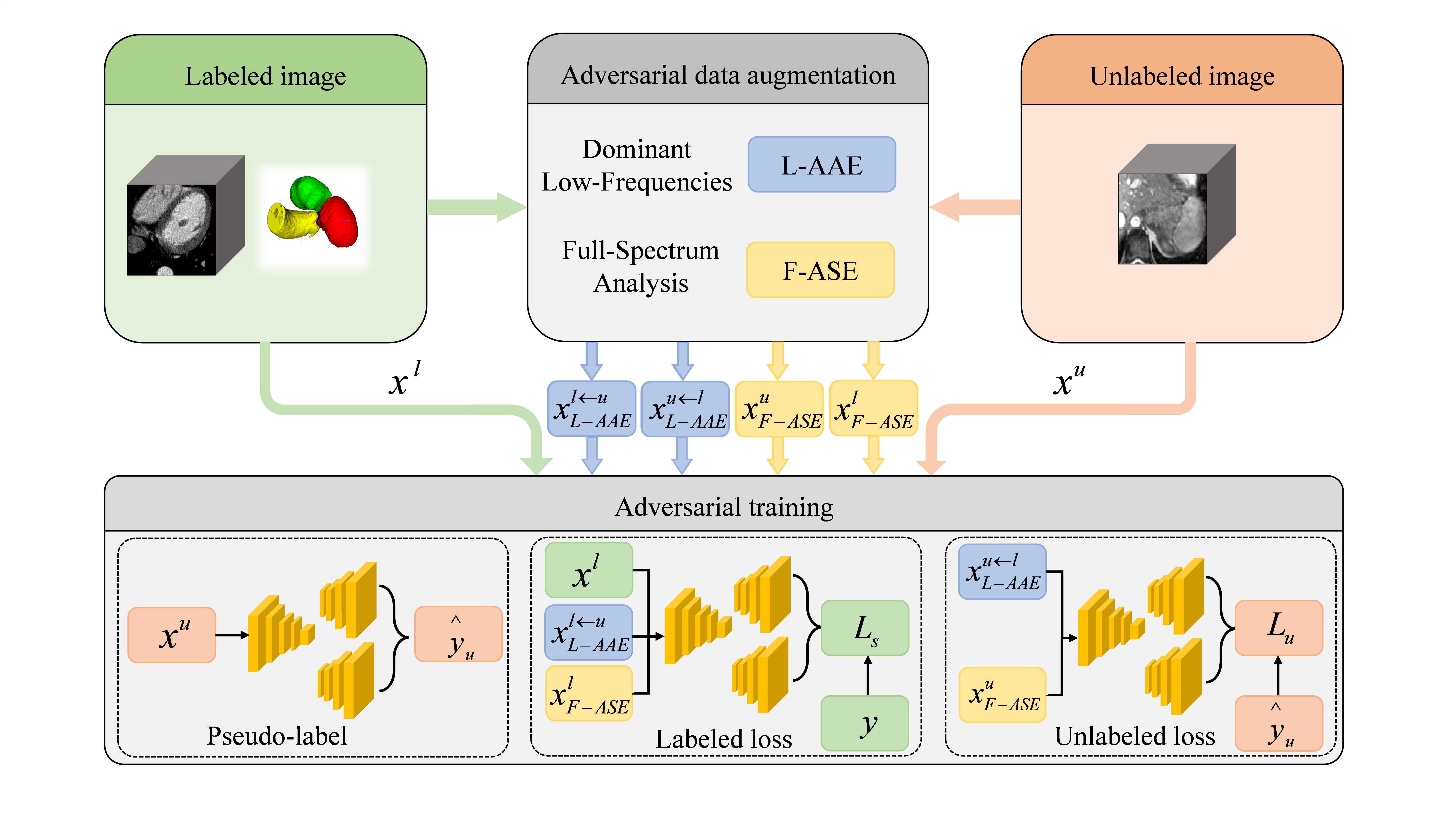
Schematic illustration of a generic semi-supervised learning framework (Image by GUI Huaqiao)
<関連情報>
- https://english.hf.cas.cn/nr/rn/202605/t20260511_1159094.html
- https://www.sciencedirect.com/science/article/abs/pii/S0031320326007260
周波数ショートカットビューからの汎用的な半教師あり3D医用画像セグメンテーションに向けて Towards generic semi-supervised 3D medical image segmentation from a frequency shortcut view
Yigeng Huang, Suwen Li, Jiatong Li, Zhuo Han, Qi Yang, Junyi Wang, Jun Lin, Xiujuan Wang, Huanqin Wang
Pattern Recognition Available online 14 April 2026
DOI:https://doi.org/10.1016/j.patcog.2026.113761
Highlights
- Generic semi-supervised 3D medical image segmentation method.
- Mitigating frequency shortcuts in semi-supervised learning.
- Adversarial data augmentation module.
- Learn a broader spectrum of frequency components.
Abstract
Developing a generic framework that supports semi-supervised learning (SSL), unsupervised domain adaptation (UDA), and semi-supervised domain generalization (Semi-DG) is essential to address the dual challenges of label scarcity and domain shift in 3D medical image segmentation. Recent studies have shown that neural networks often rely on easy-to-learn frequency components for decision-making, a phenomenon known as frequency shortcuts. This biased representation simplifies the training objective but can hinder generalization. During training, semi-supervised learning tends to rely on biased pseudo-labels, which further amplifies frequency shortcuts. Therefore, this study focuses on mitigating frequency shortcuts specifically for generic semi-supervised 3D medical image segmentation. We propose two data augmentation modules within an adversarial training framework. First, we propose a low-frequency adversarial adaptive enhancement (L-AAE) module that prevents the model from learning frequency shortcuts in dominant frequencies and mitigates domain differences via bidirectional adversarial perturbation and style transfer between labeled and unlabeled images. Additionally, we propose frequency adaptive suppression and enhancement (F-ASE). This dynamically adjusts frequency magnitudes to expand the model’s exploration of underutilized frequencies and suppress over-reliance on specific frequencies. Finally, original and adversarial samples are combined for learning within a SSL framework. Extensive experiments on relevant SSL, UDA, and Semi-DG datasets verify the superiority of the proposed method.