2026-06-02 マウントサイナイ医療システム(MSHS)
<関連情報>
- https://www.mountsinai.org/about/newsroom/2026/engineered-gut-bacteria-therapy-emerges-as-scalable-potential-alternative-to-fecal-microbiota-transplants-following-clinical-trial
- https://www.nature.com/articles/s41591-026-04442-2
再発性クロストリジオイデス・ディフィシル感染症に対する15菌株生菌製剤または同一ドナー由来糞便微生物叢移植:無作為化第1b相試験 15-strain live biotherapeutic product or same donor fecal microbiota transplant for recurrent Clostridioides difficile infection: a randomized phase 1b trial
Lukas Bethlehem,Lorenza Bartu,Gina Marke,Phyu Mar,Sari Feldman,Joseph Eggers,Constantin Ruprecht,Graham J. Britton,Varun Aggarwala,Gerold Bongers,Zhihua Li,Nancy Yang,Elizabeth L. Hohmann,Ilaria Mogno,Jeremiah J. Faith & Ari Grinspan
Nature Medicine Published:02 June 2026
DOI:https://doi.org/10.1038/s41591-026-04442-2
Abstract
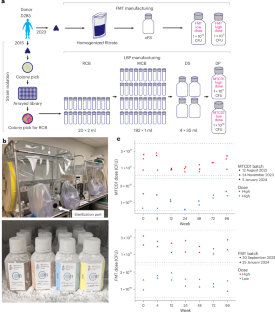
Fecal microbiota transplant (FMT) is an effective therapy for recurrent Clostridioides difficile infection (rCDI) but has undefined composition and poor scalability. In vitro manufactured live biotherapeutic products (LBPs) enable both scalability and defined strain composition but with higher manufacturing complexity, resulting in few LBP clinical trials. Here we show how an accessible platform to produce human-grade LBPs could accelerate LBP development. We provide regulatory documentation and manufacturing protocols to facilitate translating microbiome advances to human trials. With this platform, we conducted the first direct comparison of the same bacterial strains from donor-sourced FMT compared to an in vitro manufactured 15-strain LBP drug product, MTC01, for the treatment of rCDI. In a phase 1b randomized controlled trial, 18 of 20 screened patients met eligibility and were randomized equally to one of four arms: low-dose FMT (n = 4), high-dose FMT (n = 5), low-dose MTC01 (n = 4) or high-dose MTC01 (n = 5), with a 5:1 female:male ratio. The primary outcome of safety was met with 10 adverse events across eight patients, evenly spread across MTC01 (five events) and FMT (five events) recipients and no treatment-related adverse events across all four groups. For secondary outcomes of efficacy and engraftment, rCDI was prevented 8 weeks after dosing in seven out of nine LBP patients, similar to eight out of nine FMT patients. Strain engraftment was high and durable for both FMT and MTC01 with a dose effect for the LBP. ClinicalTrials.gov: NCT05911997.