2026-06-03 イェール大学
◆従来、脳は神経系の司令塔として位置付けられてきたが、近年の研究により、腸、心臓、肝臓、免疫系などの末梢臓器が分子シグナルや代謝産物、ホルモンを介して神経回路の発達や維持、行動制御に関与することが明らかになっている。特に発生段階では、各臓器から放出されるシグナルが神経細胞の分化や接続形成を誘導し、成熟後も神経機能や疾患感受性に影響を及ぼす可能性が示された。また、神経変性疾患や発達障害の一部は、脳そのものだけでなく全身臓器との相互作用の異常として理解できる可能性がある。
◆研究は、脳中心の従来モデルを超え、全身を統合した「臓器-神経系ネットワーク」という新たな視点を提案しており、神経疾患治療や再生医療の新戦略につながることが期待されている。
<関連情報>
- https://news.yale.edu/2026/06/03/beyond-brain-organs-help-shape-nervous-systems-control-them
- https://www.nature.com/articles/s41586-026-10490-y
系統と臓器のシグナルが順次作用して、臓器固有の神経系が構築される Lineage and organ signals sequentially build organ intrinsic nervous systems
I-Uen Yvonne Hsu,Jia Zhao,Yingxin Lin,Yunshan Guo,Qian J. Xu,Yuancheng Shao,Ruiqi L. Wang,Dominic Yin,Kakali Ghoshal,Rida Mourad,Ambra Pozzi,Carmen M. Halabi,Lawrence H. Young,Hongyu Zhao,Le Zhang & Rui B. Chang
Nature Published:13 May 2026
DOI:https://doi.org/10.1038/s41586-026-10490-y
Abstract
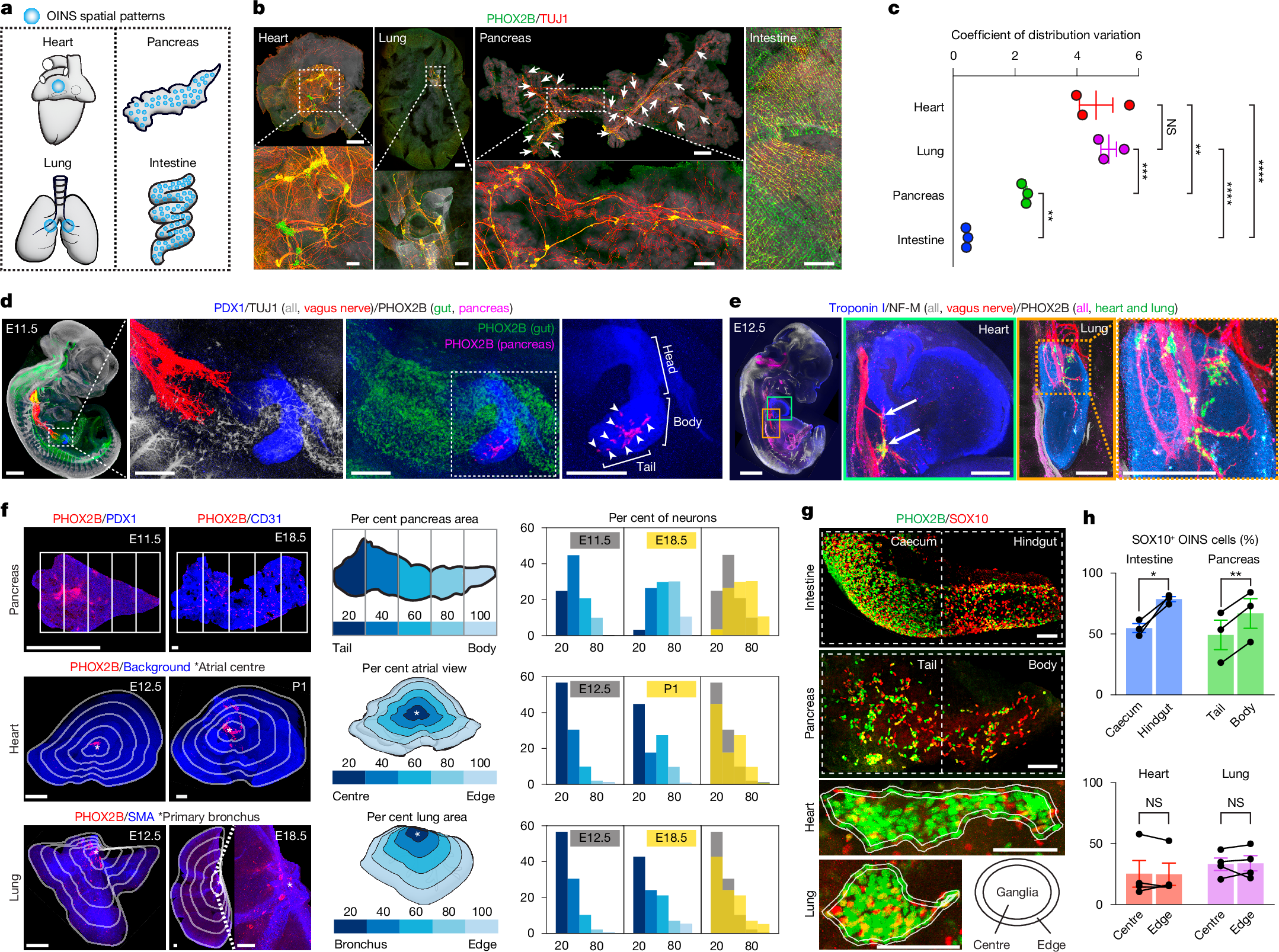
Organ intrinsic nervous systems (OINSs) are critical components of the body–brain axis and coordinate visceral organ function with systemic physiological control1,2,3,4,5,6,7. Despite their importance, how these distinct neural architectures arise from a common neural crest cell origin has remained unclear. Here we present a systems-level, cross-organ analysis of OINS development, integrating lineage tracing, 3D imaging, single-cell transcriptomics and genetic perturbations across the heart, pancreas, intestine and lungs. We show that differences in neural crest cell migratory trajectories prefigure the spatial architecture of OINSs, laying the foundation for organ-specific patterning. By contrast, molecular identity emerges largely in response to local environments, indicating that extrinsic cues have a major instructive role. Using in vitro co-cultures, we demonstrate that organ-derived cues reprogramme intrinsic neurons towards organ-specific transcriptional profiles and direct neuronal differentiation, with extracellular matrix (ECM) contact as a central mediator. In vivo, ECM–integrin signalling supports neurogenesis of intrinsic cardiac neurons, and ECM crosslinking stabilizes their stereotyped ganglionic organization. Together, these findings reveal that OINS diversity arises through a dual logic: lineage programmes prefigure spatial frameworks, whereas organ-specific cues instruct final molecular identities and architectural precision. This work establishes a conceptual paradigm for how organs actively build their nervous systems, illuminating principles that underlie body–brain integration.