2026-04-29 ミュンヘン大学(LMU)
<関連情報>
- https://www.lmu.de/en/newsroom/news-overview/news/neurophysiology-how-the-brain-recovers-from-noise-induced-damage-dc3c0ec7.html
- https://physoc.onlinelibrary.wiley.com/doi/10.1113/JP289987
騒音誘発性上オリーブ核音オフセット反応の低下と早期回復 Noise-induced reduction and early recovery of superior paraolivary nucleus sound-offset responses
Mihai Stancu, Ezhilarasan Rajaram, Joseph A. Kroeger, Benedikt Grothe, Conny Kopp-Scheinpflug
The Journal of Physiology Published: 16 April 2026
DOI:https://doi.org/10.1113/JP289987
Abstract
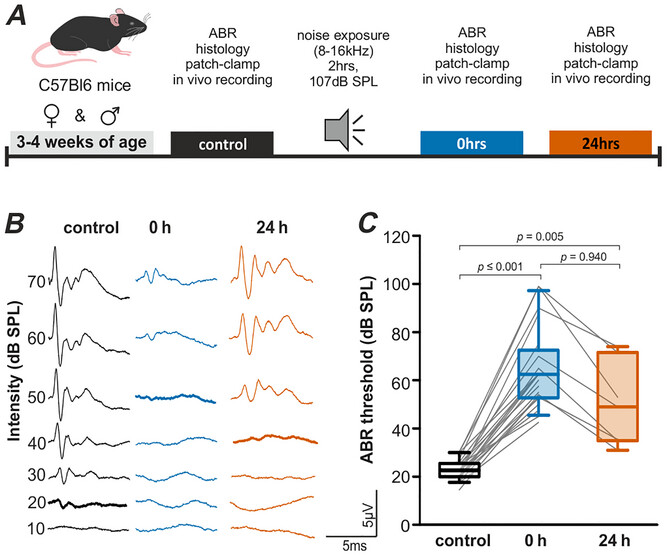
Neural circuits exhibit remarkable plasticity in response to varying intensities of sensory input. The temporal dynamics and cellular mechanisms underlying this plasticity are highly heterogeneous and possibly specific to individual circuits. Excessive noise exposure causes damage of peripheral auditory structures, such as cochlear hair cells and auditory nerve fibres, reducing afferent projection to downstream structures and initiating cascades of long-lasting compensatory changes in central auditory circuits. Amongst these changes, increased neuronal excitability, elevated spontaneous firing and increased neural gain were reported across multiple structures between the cochlear nucleus and auditory cortex. However, these findings primarily involved neurons that were responsive to sound onset (ON) and driven by excitation. Much less is known about the impact of noise exposure on neurons that are selectively activated by sound offset (OFF) and are driven by inhibition. We addressed this gap in knowledge by investigating the effects of noise exposure on intrinsic membrane properties, synaptic input patterns and sound-evoked activity in superior paraolivary nucleus (SPN) neurons, which are a population of neurons specialized for encoding sound offset. Immediately after noise exposure, SPN neurons were unresponsive to sound offset. Within the next 24 h, we observed a significant increase in the number of inhibitory synaptic terminals impinging upon SPN neurons, which was corroborated by elevated frequencies and amplitudes of inhibitory postsynaptic currents. At the same time, SPN neurons exhibited higher intrinsic excitability. Together, these changes encouraged recovery of sound-evoked OFF responses 24 h following noise exposure, suggesting circuit-specific compensatory mechanisms that enable sound OFF encoding soon after peripheral auditory insult.
Key points
- Sound-offset (OFF) responses mark the critical temporal boundary when a sound terminates; this enables encoding of sound duration and the detection of gaps in sounds and calls.
- In the mouse model, OFF responses are generated de novo in the superior paraolivary nucleus by combining sound-evoked inhibitory input with the intrinsic membrane properties of the neurons.
- The impact of noise over-exposure on these OFF responses and its implications for subsequent auditory processing is not well understood.
- Combining patch-clamp recording, immunohistochemistry and in vivo electrophysiology, we show that superior paraolivary nucleus neurons exhibit increased excitability and enhanced inhibition following noise over-exposure.
- These compensatory changes help to mediate early recovery of sound OFF responses to loud stimuli, despite the loss of auditory sensitivity at lower sound intensities.