2026-06-09 チャルマース工科大学
<関連情報>
- https://news.cision.com/chalmers/r/better-cancer-care-on-the-horizon-thanks-to-new-blood-analysis-method,c4358108
- https://academic.oup.com/bib/article/27/2/bbag111/8524997
低パス液体生検シーケンスデータにおけるコピー数異常の高感度検出 Sensitive detection of copy number alterations in low-pass liquid biopsy sequencing data
Lotta Eriksson ,Eszter Lakatos
Briefings in Bioinformatics Published:16 March 2026
DOI:https://doi.org/10.1093/bib/bbag111
Abstract
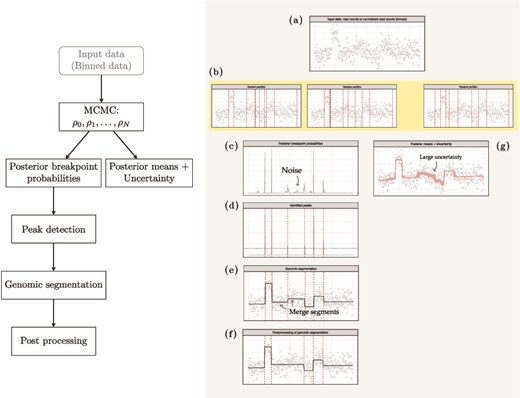
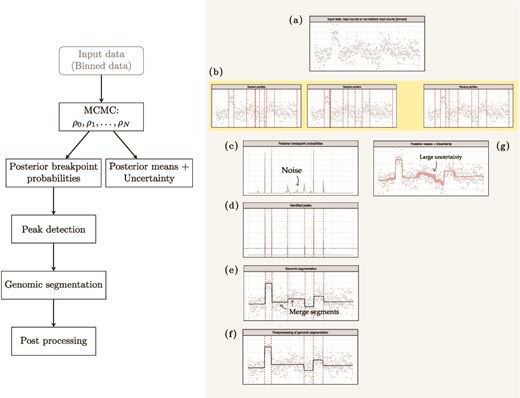
Liquid biopsies, coupled with analysis of copy number alterations (CNAs), have emerged as a promising tool for non-invasive monitoring of cancer progression and tumor composition. However, methods utilizing CNA data from liquid biopsies are limited by the low signal in the samples, caused by a low percentage of cancer DNA in the blood, and inherent noise introduced in the sequencing. To address this challenge, we developed BayesCNA, a method designed to improve signal extraction from low-pass liquid biopsy sequencing data, by utilizing a Bayesian changepoint detection algorithm. We use information of the posterior changepoint probabilities to identify likely changepoints, where a changepoint indicates a shift in the copy number state. The signal is then reconstructed using the identified partition. We show the effectiveness of the method on synthetically generated datasets and compare the method with state-of-the-art bioinformatics tools under noisy conditions. Our results show that this novel approach increases sensitivity in detecting CNAs, particularly in low-quality cases.