2026-07-06 マサチューセッツ大学アマースト校
<関連情報>
- https://www.umass.edu/news/article/fighting-worlds-deadliest-infection-pac-man-and-ai
- https://www.nature.com/articles/s41564-026-02412-5
- https://onlinelibrary.wiley.com/doi/10.1002/anie.202217777
機械学習を用いたマイコバクテリアの外膜透過性向上に寄与する化学的特徴の特定 Identification of chemical features for improved outer membrane permeation in mycobacteria using machine learning
Irene Lepori,Zichen Liu,Nelson Evbarunegbe,Shasha Feng,Turner P. Brown,Kishor Mane,Rachita Dash,Shivangi,Mitchell Wong,Ananya Naick,Amir George,Taijie Guo,Anil M. Shelke,K. Barry Sharpless,Jiajia Dong,Joel S. Freundlich,Wonpil Im,Anna G Green,Marcos M. Pires & M. Sloan Siegrist
Nature Microbiology Published:30 June 2026
DOI:https://doi.org/10.1038/s41564-026-02412-5
Abstract
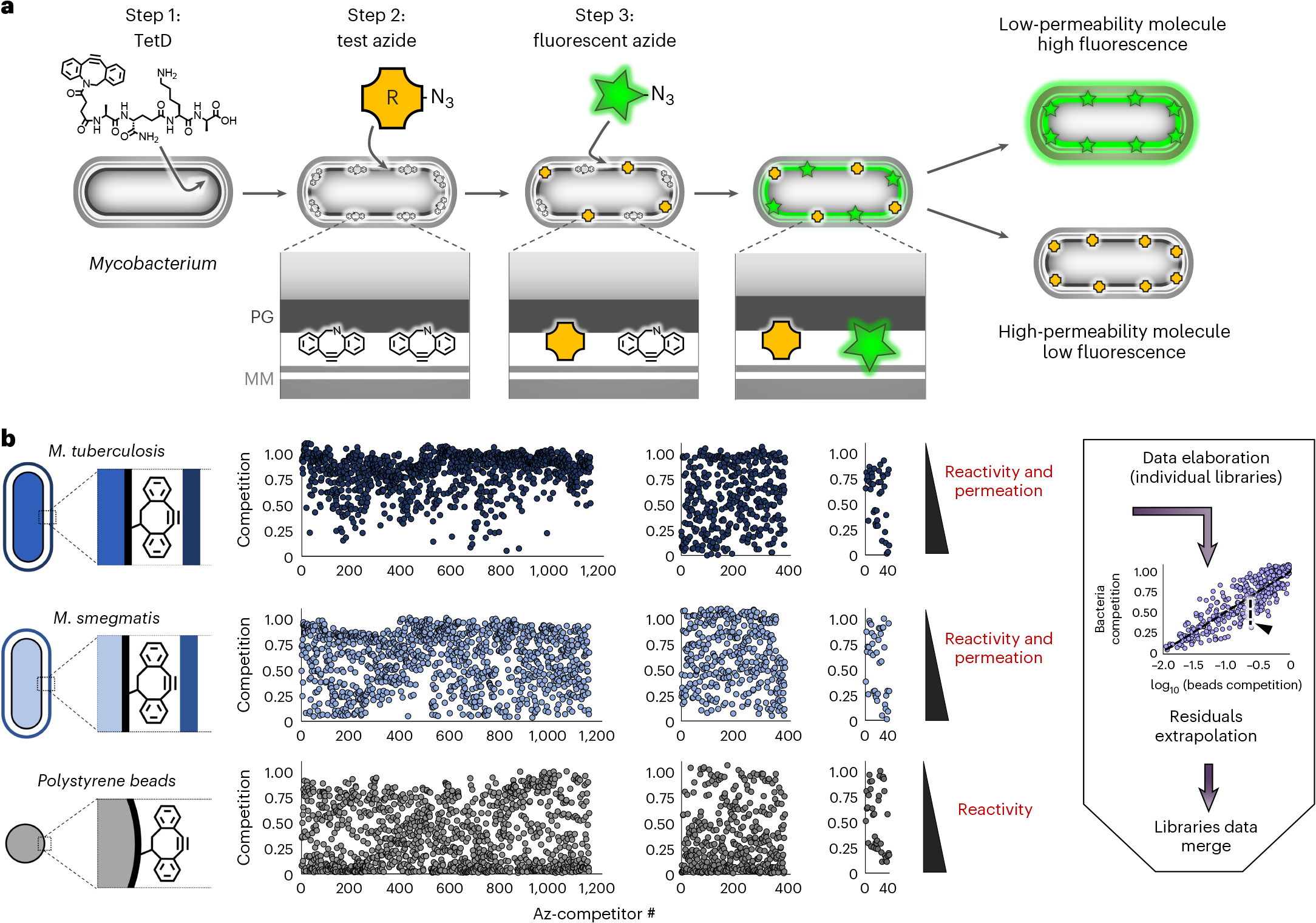
The ability of compounds to permeate and accumulate in bacterial cells is a critical determinant of antibiotic efficacy. Better therapeutics are urgently needed for the human pathogen Mycobacterium tuberculosis, yet the cell envelope, including the mycobacterial outer membrane, represents a significant barrier for drug entry, and the chemical features governing permeation remain poorly understood. Here we used the bioorthogonal click chemistry-based PAC-MAN assay to profile mycomembrane permeation of 1,572 azide-tagged compounds in M. tuberculosis and the model organism M. smegmatis. Cheminformatics and machine learning identified chemical features associated with mycomembrane permeation, which in turn had predictive value in three molecule series. Chemical predictors of mycomembrane permeation include nitrogen-containing aromatic scaffolds, such as indole, which in some cases were associated with increased anti-M. tuberculosis activity. Our data suggest a rational framework for improving mycomembrane permeation and whole-cell activity of antibiotics targeting M. tuberculosis.
生きたマイコバクテリアにおけるマイコ膜を介した小分子の透過性を評価するための代謝タグに基づく方法 A Metabolic-Tag-Based Method for Assessing the Permeation of Small Molecules Across the Mycomembrane in Live Mycobacteria
Zichen Liu, Irene Lepori, Mahendra D. Chordia, Brianna E. Dalesandro, Taijie Guo, Jiajia Dong, M. Sloan Siegrist, Marcos M. Pires
Angewandte Chemie International Edition Published: 26 January 2023
DOI:https://doi.org/10.1002/anie.202217777
Abstract
The general lack of permeability of small molecules observed for Mycobacterium tuberculosis (Mtb) is most ascribed to its unique cell envelope. More specifically, the outer mycomembrane is hypothesized to be the principal determinant for access of antibiotics to their molecular targets. We describe a novel assay that combines metabolic tagging of the peptidoglycan, which sits directly beneath the mycomembrane, click chemistry of test molecules, and a fluorescent labeling chase step, to measure the permeation of small molecules. We showed that the assay workflow was robust and compatible with high-throughput analysis in mycobacteria by testing a small panel of azide-tagged molecules. The general trend is similar across the two types of mycobacteria with some notable exceptions. We anticipate that this assay platform will lay the foundation for medicinal chemistry efforts to understand and improve uptake of both existing drugs and newly-discovered compounds into mycobacteria.