2026-07-08 ロックフェラー大学
<関連情報>
- https://www.rockefeller.edu/news/40032-ant-brain-parenting-evolution/
- https://www.nature.com/articles/s41586-026-10747-6
古代の摂食関連神経ペプチドがアリの他者育児を制御する Ancient feeding-related neuropeptides regulate alloparenting in ants
Alexander Paul,Tomas Kay,Ivan Lacroix,Vikram Chandra,Asaf Gal,Patrick K. Piekarski,Stephany Valdés-Rodríguez,Amelia L. Ritger,Katelyn S. Lee,Kip D. Lacy & Daniel J. C. Kronauer
Nature Published:08 July 2026
DOI:https://doi.org/10.1038/s41586-026-10747-6
Abstract
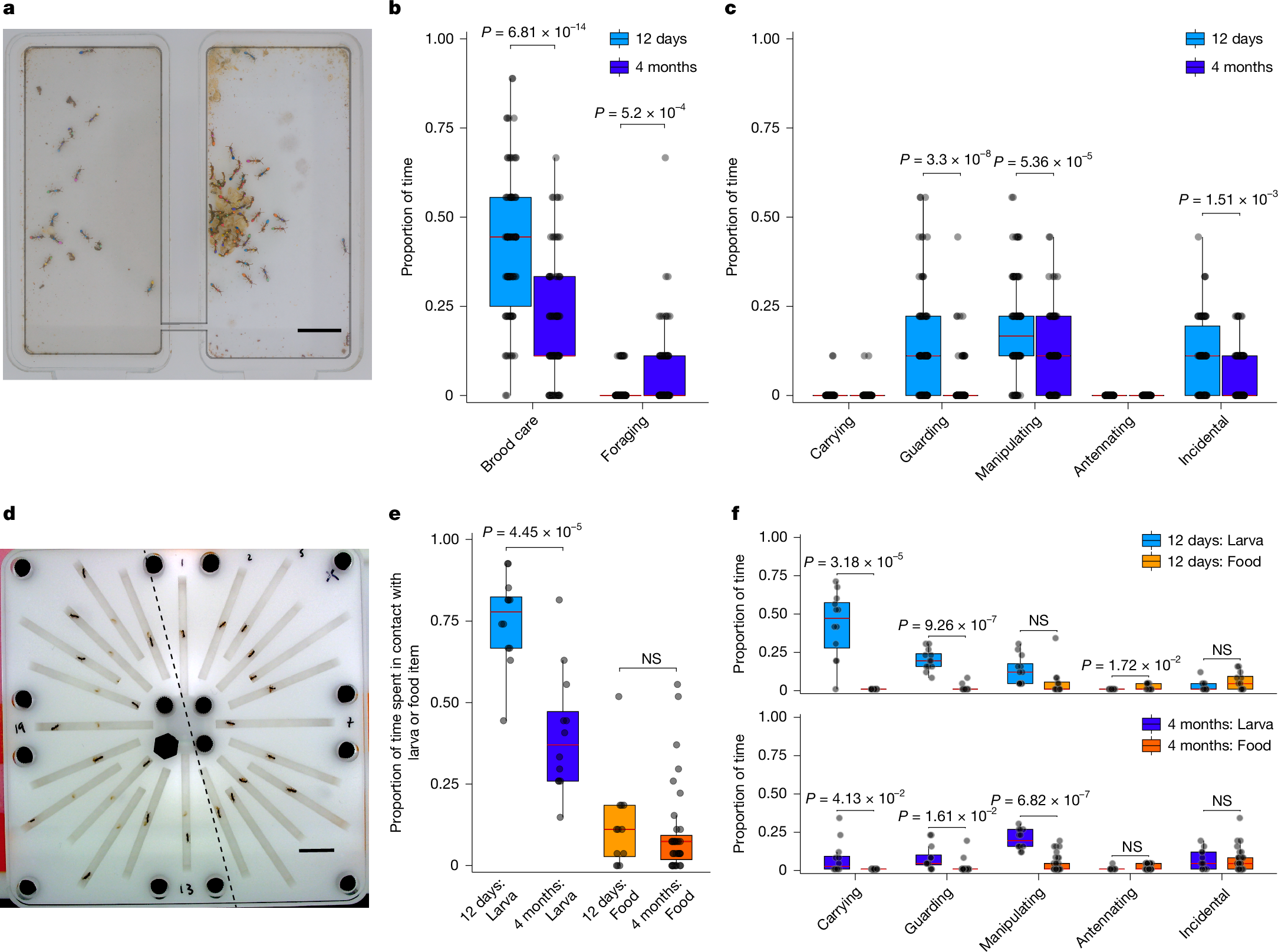
Alloparental care and division of labour are hallmarks of insect societies1. Social insect workers typically care for brood within the nest when they are young and transition to foraging outside the nest as they age2,3,4,5. This provides a powerful paradigm to study the neural basis of parenting and age-related behavioural change. Although previous work has interrogated aspects of these dynamics6,7,8,9,10,11,12,13,14, the underlying neural and molecular mechanisms remain poorly understood. Here, using an unbiased pharmacological screen of neuropeptides, we show that two ancestral regulators of feeding, neuropeptide F (NPF) and allatostatin A (AstA), modulate brood-care behaviour in the clonal raider ant. Through functional manipulations, we show that NPF increases brood-care behaviour, whereas AstA has the opposite effect. Furthermore, we find that the levels of NPF and AstA in the brain change naturally as ants age, suggesting that these changes underlie the age-related changes in brood-care behaviour. Finally, we show that, as in solitary species15,16, NPF and AstA remain sensitive to nutritional state, and nutritional state affects brood-care behaviour accordingly. Our results reveal that evolution has co-opted molecular mechanisms that regulated feeding ancestrally to enable cooperative brood care and age-associated division of labour.