2026-07-08 東京大学
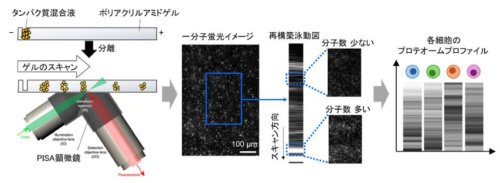
図1:Single-cell PAGE-PISA 法の概念図
<関連情報>
- https://www.u-tokyo.ac.jp/focus/ja/press/z0111_00100.html
- https://www.u-tokyo.ac.jp/content/400291494.pdf
- https://www.nature.com/articles/s41467-026-74840-0
ゲル電気泳動と3D単一分子イメージングによる単一細胞プロテオームの分子プロファイリング Molecular profiling of the single-cell proteome via gel electrophoresis and 3D single-molecule imaging
Latiefa Kamarulzaman,Sooyeon Kim,Takuya Hidaka,Misaki Tsuchida & Yuichi Taniguchi
Nature Communications Published:08 July 2026
DOI:https://doi.org/10.1038/s41467-026-74840-0
Abstract
Recent advances in shotgun proteomics and immunoassays have yielded powerful single-cell proteomics technologies. However, current methods lack the sensitivity required to comprehensively quantify protein abundances in individual cells. Here, we present single-cell PAGE-PISA, an ultra-sensitive proteome profiling strategy that combines gel electrophoresis with 3D single-molecule fluorescence imaging. Our approach labels all proteins in single cells with fluorescent dyes, separates them by electrophoresis, and counts with single-molecule resolution. This technique quantified over 107 protein copies from a single mammalian cell with the sensitivity to detect low-abundance proteins down to 105 copies per species. Single-cell PAGE-PISA successfully classified cells into distinct cell types based on their proteomic profiles. Furthermore, our single-cell proteome data strongly correlated with predicted developmental states during cardiomyocyte differentiation, providing complementary information to single-cell transcriptome data. Together, single-cell PAGE-PISA enables highly sensitive and quantitative proteome profiling at the single-cell level, capturing subtle proteomic differences that distinguish diverse cellular states.