2026-08-03 カリフォルニア大学ロサンゼルス校 (UCLA)
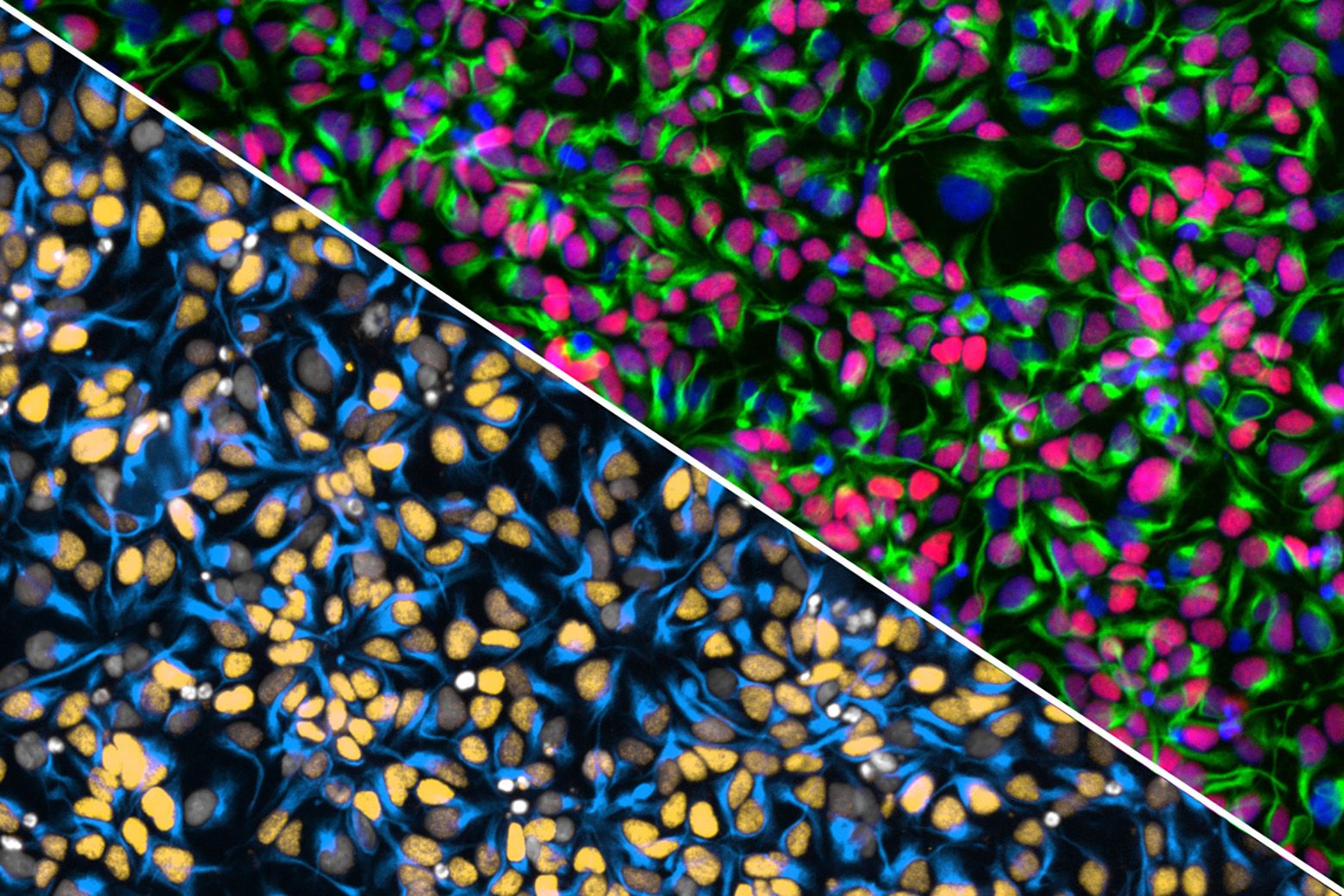
Human stem cell-derived neural progenitor cells in a cell village. Credit: Timothy Derebenskiy/Wells Lab
<関連情報>
- https://newsroom.ucla.edu/releases/scientists-build-cell-villages-map-genetics-brain-cell-fitness
- https://www.cell.com/ajhg/fulltext/S0002-9297(26)00271-5
細胞村とディリクレモデルマップによるヒト細胞適応度遺伝学 Cell villages and Dirichlet modeling map human cell fitness genetics
Chloe Hanson ∙ Timothy Derebenskiy ∙ Ana Rodriguez Vega ∙ … ∙ Patrick Allard ∙ Harold Pimentel ∙ Michael F. Wells
American Journal of Human Genetics Published:August 3, 2026
DOI:https://doi.org/10.1016/j.ajhg.2026.07.005
Summary
The capacity of cells to proliferate and survive is central to development and disease. Assays that measure cell fitness are therefore a cornerstone of biology, but traditional techniques lack donor diversity and have high technical variability that impedes scale and reproducibility. To overcome these barriers, we designed and validated a “cell village”-based fitness screening approach using pooled cultures of 12–39 genetically distinct human neural progenitor cell (NPC) lines. We also developed Townlet to establish a foundational statistical framework based on Dirichlet regression for analyzing proportional data from cell villages. Applying these systems, we identified hyperproliferation in NPCs harboring the autism risk factor chromosome 16p11.2 deletion, mapped common genetic variants near ZFHX3 associated with NPC proliferation rate, and discovered genetic modifiers of lead (Pb) sensitivity implicating ARNT2. Together, these experimental and analytical tools advance a scalable, genetically diverse in vitro platform for dissecting human variation in cell fitness and gene-environment interactions.