2026-08-10 スイス連邦工科大学ローザンヌ校(EPFL)
<関連情報>
- https://actu.epfl.ch/news/ai-model-maps-tumor-tissue-to-improve-cancer-care/
- https://www.nature.com/articles/s41586-026-10884-y
仮想組織基盤モデルは、様々なスケールにわたる空間プロテオミクスを解明する The Virtual Tissues foundation model resolves spatial proteomics across scales
Johann Wenckstern,Eeshaan Jain,Benedikt von Querfurth,Yexiang Cheng,Kiril Vasilev,Matteo Pariset,Phil F. Cheng,Petros Liakopoulos,Olivier Michielin,Andreas Wicki,Gabriele Gut & Charlotte Bunne
Nature Published:05 August 2026
DOI:https://doi.org/10.1038/s41586-026-10884-y
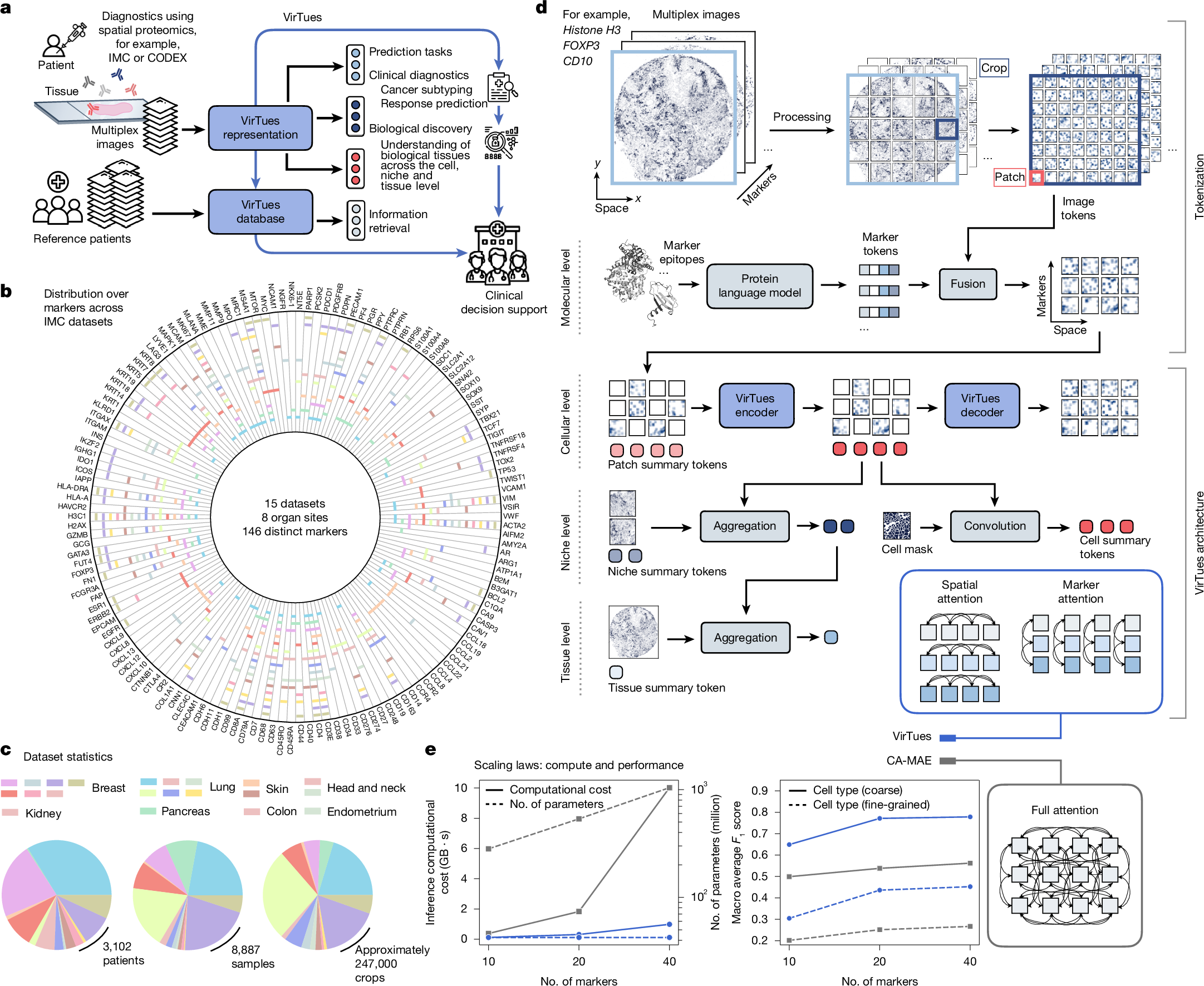
Abstract
Spatial proteomics technologies have transformed our understanding of complex tissue architecture in cancer but present unique challenges for computational analysis1. Each study uses a different marker panel and protocol, and most methods are tailored to single cohorts, which limits knowledge transfer and robust biomarker discovery. Here we present Virtual Tissues (VirTues), a general-purpose foundation model for spatial proteomics that learns marker-aware, multi-scale representations of proteins, cells, niches and tissues directly from multiplex imaging data. From a single pretrained backbone, VirTues supports marker reconstruction, cell segmentation and typing, niche annotation, spatial biomarker discovery and patient stratification, including zero-shot annotation across heterogeneous panels and datasets. In triple-negative breast cancer, VirTues-derived biomarkers predict anti-PD-L1 chemo-immunotherapy response2 and stratify disease-free survival in an independent cohort3, outperforming state-of-the-art biomarkers derived from the same datasets and current clinical stratification schemes.