2026-09-30 マウントサイナイ医療システム(MSHS)
<関連情報>
- https://www.mountsinai.org/about/newsroom/2026/people-with-long-covid-who-used-a-noninvasive-magnetic-therapy-headset-show-improved-cognitive-function-and-mood
- https://academic.oup.com/braincomms/advance-article/doi/10.1093/braincomms/fcag364/8841135
長期コロナ患者における認知機能障害に対するマイクロテスラ磁気療法:無作為化パイロット研究 Microtesla magnetic therapy for cognitive impairment in long COVID: a randomized pilot study
Alexandra Canori, PhD, Eric Watson, PhD, Devanshi Patel, MA, Arianna Fiorentino, MSc, Christopher Santiago, BS, David Maltz, MSE, Blake Gurfein, PhD, David Putrino, PhD, Jacqueline Becker, PhD
Brain Communications Published:28 September 2026
DOI:https://doi.org/10.1093/braincomms/fcag364
Abstract
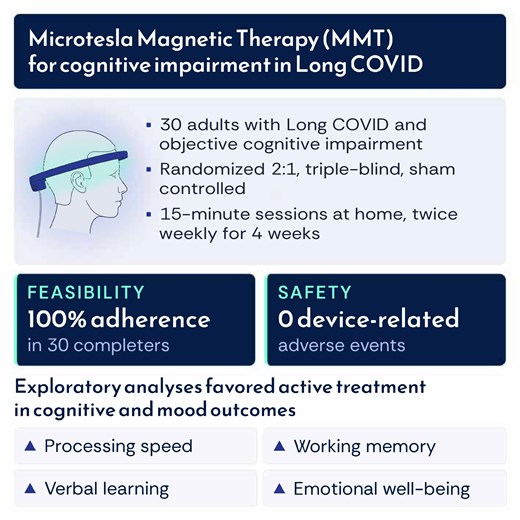
Cognitive impairment is common in post-acute sequelae of severe acute respiratory syndrome coronavirus 2 infection (long COVID) and substantially affects function and quality of life. Evidence suggests that sustained neuroinflammation, cerebrovascular dysfunction, and mitochondrial impairment contribute to cognitive symptoms. Microtesla Magnetic Therapy (MMT) is a transcranial, low-amplitude radiofrequency magnetic field intervention that has shown anti-inflammatory and neuroprotective effects in preclinical models, suggesting potential value in long COVID and other neurological disorders. This is the first randomized controlled trial of MMT for long COVID cognitive impairment.
We evaluated the feasibility (primary) and safety (secondary) of at-home MMT in individuals with objective cognitive impairment from long COVID.
Thirty participants were randomized 2:1 to active or sham MMT and self-administered 15-minute treatments at home twice weekly for 4 weeks, with remote monitoring, using a head-worn device delivering a nonthermal radiofrequency magnetic field to the whole brain. Feasibility was defined as completing at least 80% of prescribed treatments and all study visits. Safety was assessed by adverse events. Cognitive function and self-reported mood and quality of life were exploratory outcomes assessed at baseline, Week 4 (post-treatment), and Week 8 (follow-up).
Feasibility was high: all participants who completed the study adhered to 100% of treatments, and usability ratings were strong. No device-related adverse events occurred. Compared with sham, active MMT participants showed significantly greater improvement from baseline to Week 8 in Wechsler Adult Intelligence Scale Digit Span Sequencing (p = 0.026), Hopkins Verbal Learning Test-Revised Total Recall (p = 0.044), and Delis-Kaplan Executive Function System Color Naming (p = 0.049). Other measures of attention, processing speed, and executive function did not differ significantly between groups. Emotional well-being on the 36-Item Short Form Survey improved significantly more with active MMT at Week 8 (p = 0.017). Depression and anxiety decreased in both groups; the anxiety reduction was greater with active treatment in the linear mixed-effects model (week × treatment interaction, p = 0.038) but not in the between-group change score comparison (p = 0.057).
At-home MMT was feasible, safe, and well tolerated in individuals with cognitive impairment from long COVID. These preliminary, exploratory findings showed nominally significant between-group differences favoring active treatment on selected cognitive measures and emotional well-being and require confirmation in larger, adequately powered trials.