2026-06-19 国立循環器病研究センター
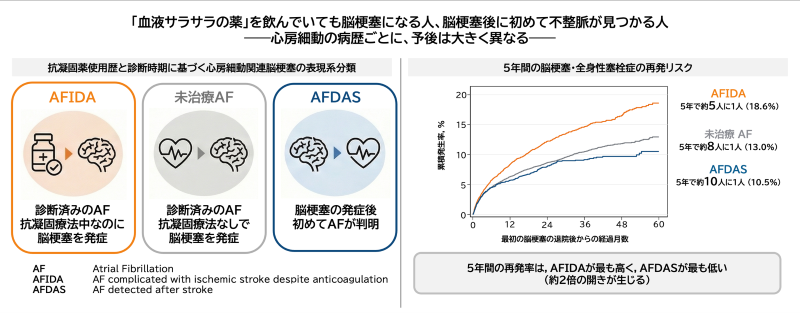
心房細動と脳梗塞の関係を3つのタイプに分類し、5年間の再発リスクを比較した。抗凝固薬を服用中に脳梗塞を発症した人(AFIDA)は再発リスクが最も高く(18.6%)、脳梗塞後に初めて心房細動が見つかった人(AFDAS)は最も低かった(10.5%)。[作成:江頭柊平,(イラストの一部はNotebookLMにより作成)]
<関連情報>
- https://www.ncvc.go.jp/pr/release/pr_53068/
- https://www.neurology.org/doi/10.1212/WNL.0000000000218198
虚血性脳卒中後の長期転帰:検出時期と抗凝固療法歴によって定義される心房細動表現型別 Long-Term Outcomes After Ischemic Stroke Across Atrial Fibrillation Phenotypes Defined by Detection Timing and Prior Anticoagulation Status
Shuhei Egashira, Kosuke Inoue, Masatoshi Koga, Tatsushi Toda, and Yuichi Imanaka
Neurology Published:June 18, 2026
DOI:https://doi.org/10.1212/WNL.0000000000218198
Abstract
Background and Objectives
Atrial fibrillation (AF)–associated ischemic stroke is often managed as a single clinical entity; however, prognosis may vary depending on whether AF was detected after the stroke or whether the stroke occurred despite prior oral anticoagulant (OAC) use. We aimed to describe long-term outcomes after ischemic stroke across 3 distinct AF phenotypes: AF complicated by ischemic stroke despite prior anticoagulation (AFIDA), AF complicated by ischemic stroke without prior anticoagulation (OAC-naive AF), and AF detected after stroke (AFDAS).
Methods
This nationwide cohort study used the DeSC-IQVIA database, an administrative claims database covering approximately 16 million individuals in Japan. Adult stroke survivors with AF discharged with OAC prescriptions between April 2014 and January 2025 were included. Three mutually exclusive AF phenotypes defined by AF detection timing and prior anticoagulation status: AFIDA, OAC-naive AF, and AFDAS (diagnosed during the index hospitalization). The primary outcomes were hospitalization for recurrent ischemic stroke or systemic embolism (SE). The secondary outcomes included major bleeding, heart failure (HF) hospitalization, and all-cause mortality. Cumulative incidence was estimated using the Aalen-Johansen method, accounting for the competing risk of death. Adjusted subdistribution hazard ratios (aSHRs) were estimated using Fine-Gray models.
Results
Among 21,586 patients (median age, 83 years [interquartile range (IQR), 78–88 years]; 10,604 [49.1%] female), 6,604 (30.6%) were classified as having AFIDA, 11,875 (55.0%) as having OAC-naive AF, and 3,107 (14.4%) as having AFDAS. During the 38,593 person-years of follow-up, 2,028 patients experienced stroke/SE. The 5-year cumulative incidence of stroke/SE was highest in AFIDA (18.6% [95% CI 17.0%–20.2%]), followed by OAC-naive AF (13.0% [95% CI 12.0%–13.9%]) and AFDAS (10.5% [95% CI 9.0%–12.1%]). Compared with OAC-naive AF, AFIDA was associated with a higher risk of recurrent stroke/SE (aSHR, 1.38; 95% CI 1.25–1.52), whereas AFDAS was associated with a lower risk (aSHR, 0.87; 95% CI 0.75–1.00). Among secondary outcomes, AFIDA showed an increased risk of HF hospitalization (aSHR, 1.15; 95% CI 1.02–1.31).
Discussion
Long-term prognosis after AF-associated stroke is heterogeneous across AF phenotypes, with AFIDA representing a high-risk group and AFDAS representing a low-risk group. These findings highlight the need to treat these clinically identifiable phenotypes as distinct target populations for secondary prevention strategies and future clinical trials.