2026-06-19 琉球大学
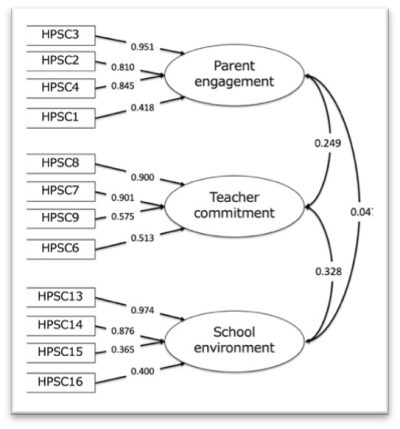
図1. J-HSPCS の因子構造
<関連情報>
日本語版健康増進学校文化尺度の妥当性:職場における社会的資本との多層的な関連性 Validity of the Japanese version of the Health Promoting School culture scale: multilevel associations with workplace social capital
Akira Kyan,Kiyonori Masukawa,Minoru Takakura
Health Promotion International Published:02 June 2026
DOI:https://doi.org/10.1093/heapro/daag071
Abstract
The World Health Organization’s Health Promoting School (HPS) framework takes a multi-component approach integrating health into education, environment, policy, and community partnership. Effective implementation depends not only on resources but also on school culture—the shared values and norms that sustain health promoting practice. The Health Promoting School Culture Scale (HPSCS) measures these cultural and normative foundations. This study validated a Japanese version (J-HPSCS) and examined its psychometric and multilevel properties. A web-based survey was administered to 1148 staff from 135 public high schools in one Japanese prefecture. After forward–backward translation and expert review, confirmatory factor analysis tested factorial validity; convergent and discriminant validity were examined using composite reliability, average variance extracted, and the Fornell–Larcker criterion. Multilevel models assessed between-school variation and concurrent validity using workplace social capital as an external correlate. Four items on community partnerships, school meals, and active transport showed weak performance and were removed. The refined 12-item, three-factor structure (Parent engagement in the school, School/Teachers’ Commitment to Student Health, and School Physical Environment) demonstrated acceptable reliability and validity. J-HPSCS scores were positively associated with workplace social capital at both individual and school levels, with stronger effects at the school level. The J-HPSCS provides a concise, reliable measure of school organizational culture that supports health promoting practice and can be used to monitor implementation and inform policy within educational systems.