
2026-09-23 フロリダ大学 (UF)
<関連情報>
新興感染症における人為的痕跡 The anthropogenic fingerprint on emerging infectious diseases
Rory Gibb, Sadie J. Ryan, David M. Pigott, Maria del Pilar Fernandez, Renata L. Muylaert, Gregory F. Albery, Daniel J. Becker, Jason K. Blackburn, Hernan Caceres-Escobar, Michael Celone, Evan A. Eskew, Hannah K. Frank, Barbara A. Han, Erin N. Hulland, Kate E. Jones, Rebecca Katz, Adam Kucharski, Direk Limmathurotsakul, Catherine A. Lippi, Joshua Longbottom, Juan Fernando Martinez, Jane P. Messina, Elaine O. Nsoesie, David W. Redding, … Colin J. Carlson
Nature Published:23 September 2026
DOI:https://doi.org/10.1038/s41586-026-11058-6
Abstract
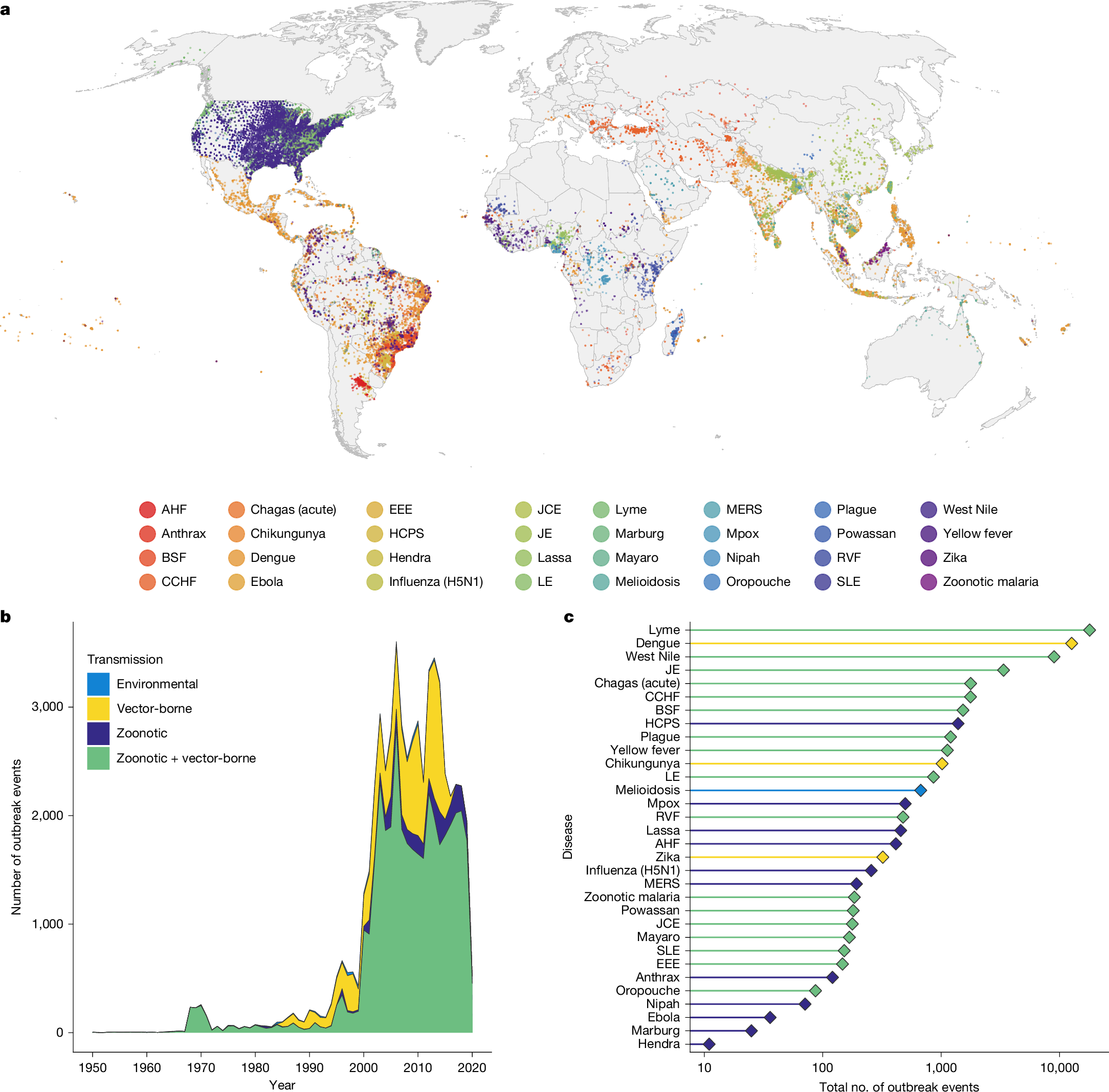
Emerging infectious diseases are a hallmark of the Anthropocene1,2. Human-driven ecosystem changes and human–wildlife–livestock contact can drive the emergence of zoonotic and vector-borne diseases3,4,5, but how much these processes shape landscapes of outbreak risk is poorly understood, beyond a few well-studied systems6,7,8. Here we consolidate 58,319 outbreak event records for 32 diseases and systematically test how 16 hypothesized social and environmental drivers impact outbreak geographies, while accounting for detection and reporting biases. We show that outbreak risks are typically highest in mosaic landscapes where people and livestock live alongside forests and fragmented ecosystems. These combined factors, along with long-term declines in precipitation, share strong impacts across several vector-borne diseases (for example, dengue, Lyme disease and zoonotic arboviruses). By contrast, directly transmitted zoonoses (for example, Ebola and mpox) share few common drivers, and the impacts of most other anthropogenic pressures (for example, deforestation, climate warming and agricultural intensification) vary widely between diseases. Most consistently, the observed geography of outbreaks is shaped by healthcare access: reporting declines by a median of 32% (range across diseases: 1.2–96.7%) for each additional hour’s travel time from a health facility. Our findings underscore that infectious disease spillover and emergence are multi-causal, and that no one-size-fits-all strategy can prevent epidemics and pandemics. Ecosystem-based public health interventions9 should always follow system-specific evidence, and be paired with greater investment in health systems and One Health pathogen surveillance.

