2026-10-01 北海道大学,雪印種苗,株式会社栄養・病理学研究所
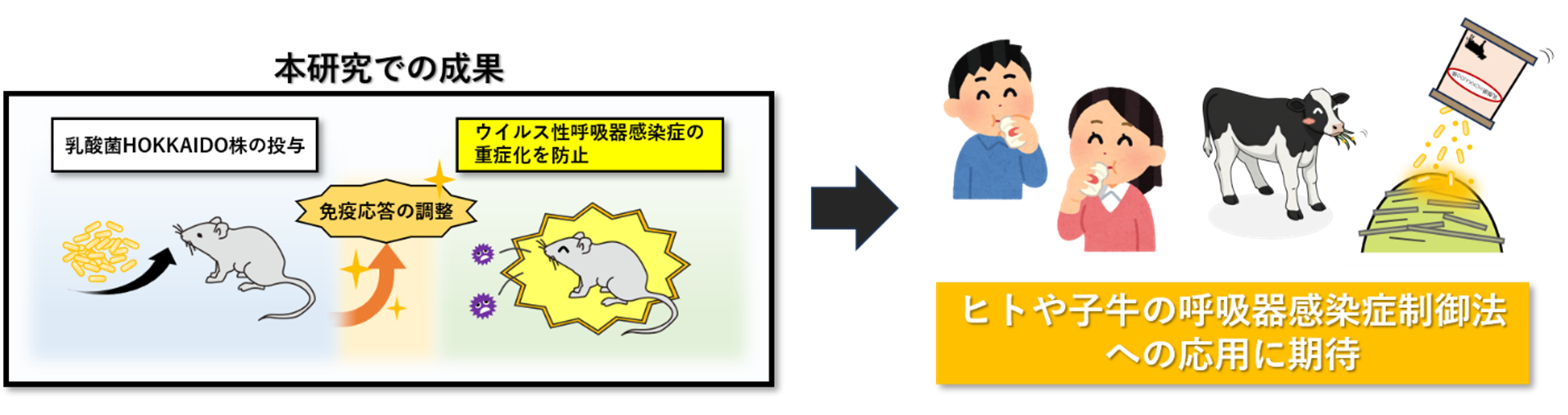
本研究成果の応用例
<関連情報>
- https://www.hokudai.ac.jp/news/2026/10/post-2455.html
- https://www.frontiersin.org/journals/immunology/articles/10.3389/fimmu.2026.1929200/full
L乳酸菌Lactiplantibacillus plantarum HOKKAIDO株は、肺胞マクロファージの働きを介して呼吸器感染症に対する抗ウイルス効果を誘導する actiplantibacillus plantarum HOKKAIDO strain drives alveolar macrophage-dependent antiviral protection against respiratory infection
Mari Ikehata,Tomohiro Okagawa,Hayato Nakamura,Maho Inoue,Masami Morimatsu,Kumiko Yoshimatsu,Takamitsu Tsukahara,Kentaro Abe,Satoru Konnai
Frontiers in Immunology Published:21 September 2026
DOI:https://doi.org/10.3389/fimmu.2026.1929200
Abstract
Calves’ immature immune systems make them susceptible to various infections. In particular, diarrhea and respiratory diseases impair growth and increase mortality, resulting in substantial economic losses in the cattle industry. Probiotics are living microorganisms that confer health benefits to the host and are increasingly recognized as promising preventive and supportive therapies for calf infections. Our previous study revealed that Lactiplantibacillus plantarum HOKKAIDO strain (Lp-HKD) reduces intestinal pathology and diarrhea severity in bovine rotavirus-infected calves. We also demonstrated that Lp-HKD activates bovine immune cells, including monocytes and T cells, and exerts an antiviral effect by inducing antiviral cytokines in vitro. Based on these findings, we hypothesized that Lp-HKD might also protect against respiratory viral infections. In this study, we investigated the antiviral effects of Lp-HKD against respiratory infection in a mouse model. DBA/2 mice were intragastrically administered Lp-HKD or phosphate-buffered saline for 7 days prior to intranasal inoculation with Sendai virus (SeV). Lp-HKD administration improved survival and reduced weight loss after infection. At 7 days post-infection, SeV levels in the lungs were significantly lower in Lp-HKD–treated mice. Notably, SeV infection significantly decreased alveolar macrophage numbers in control mice, but not in Lp-HKD–treated mice. Furthermore, Lp-HKD treatment reduced the production of inflammatory cytokines and chemokines in bronchoalveolar lavage fluid. Lp-HKD administration was also associated with modest changes in the gut microenvironment, including altered abundance of specific bacterial taxa and increased microbial richness. Conversely, the depletion of alveolar macrophages abolished the protective effect of Lp-HKD, demonstrating that these cells are essential mediators of Lp-HKD antiviral activity. Collectively, these findings indicate that Lp-HKD modulates host immune responses and reduces the severity of viral respiratory infection in mice, underscoring its potential as a viable preventive strategy against viral respiratory diseases.