2026-09-30 国立精神・神経医療研究センター,横浜市立大学
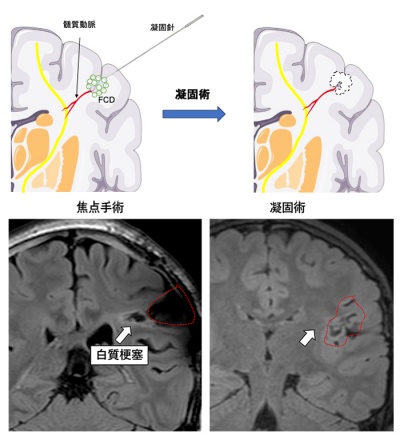
図1 RFTCの概念図と術後画像
<関連情報>
- https://www.ncnp.go.jp/topics/detail.php?@uid=IYAQ2PIPTG82qpwH
- https://onlinelibrary.wiley.com/doi/10.1002/epi.70454
局所皮質形成異常に対する体積ベースの定位的ラジオ波熱凝固療法:島弁蓋部および中心領域における切除術に代わる、より安全な選択肢となる可能性 Volume-based stereotactic radiofrequency thermocoagulation for focal cortical dysplasia: A potentially safer alternative to resection in insulo-opercular and central regions
Takahiro Hayashi, Keiya Iijima, Yutaro Takayama, Yosuke Okazaki, Naoki Ikegaya, Yuiko Kimura, Yuu Kaneko, Risa Kagaya, Yukio Kimura, Noriko Sato, Masaki Iwasaki
Epilepsia Published: 23 September 2026
DOI:https://doi.org/10.1002/epi.70454
Abstract
Objective
Deep white matter infarction caused by injury to the medullary arteries is a crucial cause of postoperative neurological deficits following surgical resection of focal cortical dysplasia (FCD) in the central and insulo-opercular cortices. Volume-based radiofrequency thermocoagulation (v-RFTC) is a less-invasive ablation technique that may reduce the risk of white matter infarction. This study compared the safety and efficacy of v-RFTC with surgical resection of FCD.
Methods
We retrospectively reviewed patients with drug-resistant epilepsy who underwent surgical resection or v-RFTC for FCD between January 2018 and December 2024. The primary endpoint was postoperative deep white matter infarction on magnetic resonance imaging. The secondary endpoints included 1-year seizure outcomes and postoperative neurological deficits. Infarct volume was assessed using apparent diffusion coefficient maps obtained during the acute postoperative period. To account for differences in treatment, 1:1 matching was performed based on treatment volume.
Results
The study included 45 surgeries from 42 patients (30 resection, 15 v-RFTC). In matched analyses (n = 13 pairs), the v-RFTC group demonstrated a significantly lower incidence of deep white matter infarction compared with the resection group (15.4% vs. 84.6%, p = .003). Furthermore, the infarct volume was significantly smaller following v-RFTC (median difference = −192.5 mm3, 95% confidence interval = −1008.3 to −96.6 mm3, p = .002). Persistent postoperative neurological deficits due to infarction occurred only after resection in the central region. At 1 year, favorable seizure outcomes (International League Against Epilepsy classes 1–3) were numerically similar between the resection (76.6%) and v-RFTC (73.3%) groups.
Significance
Compared with surgical resection, v-RFTC was associated with a markedly smaller volume of postoperative deep white matter infarction, suggesting that v-RFTC may represent a safer therapeutic option for FCD in high-risk regions, such as the insulo-opercular and central cortices. Nevertheless, large-scale prospective studies with extended follow-up are warranted to establish its long-term clinical efficacy.