2026-10-13 チャルマース工科大学
<関連情報>
- https://news.cision.com/chalmers/r/beyond–bad–cholesterol–new-clues-to-the-risk-of-heart-disease,c4407724
- https://academic.oup.com/eurheartj/advance-article/doi/10.1093/eurheartj/ehag718/8772973
- https://medibio.tiisys.com/154124/
アポリポタンパク質B含有リポタンパク質:血漿プロテオミクス解析により明らかになった動脈硬化における明確な役割 Apolipoprotein B-containing lipoproteins: distinct roles in atherosclerosis revealed by plasma proteomic profiling
Jakub Morze, Elias Björnson, Michael Y Mi, Martin Adiels, Giorgio E M Melloni, Gonçalo R da Silva, Andrzej Rynkiewicz, Nicholas A Marston, Marta Guasch-Ferré, Michael Y Tsai, …
European Heart Journal Published:31 August 2026
DOI:https://doi.org/10.1093/eurheartj/ehag718
Abstract
Background and Aims
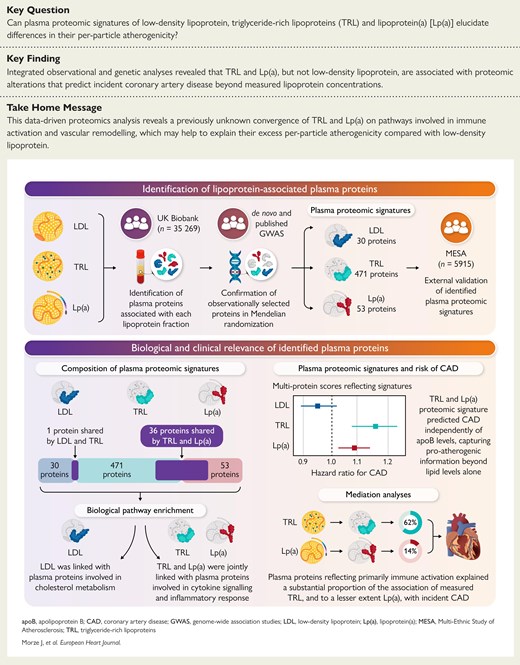
All apolipoprotein B-containing lipoproteins are established causal factors for coronary artery disease (CAD). We aimed to identify robust proteomic signatures of LDL, triglyceride-rich lipoproteins (TRL), and lipoprotein(a) [Lp(a)] and to evaluate whether these signatures illuminate biological processes underlying differences in per-particle atherogenicity.
Methods
We identified plasma proteins associated with LDL, TRL, and Lp(a) concentrations using multivariable-adjusted regression across 2918 proteins in a primary prevention cohort based on UK Biobank (n = 35 269) and corroborated findings using one-sample Mendelian randomization. Proteins consistently identified by both approaches were summarized into lipoprotein-specific multi-protein scores and associated with incident CAD (n = 1599 events) using Cox regression. High-dimensional mediation analysis quantified the proportion of lipoprotein-associated CAD risk explained by proteomic alterations. Findings were replicated in the Multi-Ethnic Study of Atherosclerosis (n = 5915).
Results
Requiring concordance between observational and Mendelian randomization analyses (both Bonferroni-adjusted P < .05), we identified 30 proteins associated with LDL, 471 with TRL, and 53 with Lp(a). The TRL and Lp(a) signatures were distinct from the LDL signature yet overlapped substantially with each other (36 shared proteins), with common enrichment in inflammatory pathways. After adjustment for potential confounders and measured lipoprotein concentrations, the multi-protein scores for TRL [hazard ratio (HR) per 1-SD increase 1.16, 95% confidence interval (95% CI): 1.08–1.24] and Lp(a) (HR 1.09, 95% CI: 1.03–1.15), but not LDL (HR 0.95, 95% CI: 0.89–1.02), were associated with incident CAD. Mediation analysis was consistent with immune activation and vascular remodelling markers mediating TRL-associated CAD risk (proportion mediated, 62%) and, in part, Lp(a)-associated risk (14%).
Conclusions
Beyond arterial lipid deposition, TRL and Lp(a) converge on inflammatory and vascular remodelling pathways, which, under the assumptions of observational mediation analysis, may explain their excess per-particle atherogenicity compared with LDL.