2025-06-29 東京大学
<関連情報>
- https://www.u-tokyo.ac.jp/content/400266851.pdf
- https://ijbnpa.biomedcentral.com/articles/10.1186/s12966-025-01780-1
食事の食塩摂取に寄与する食事の背景と食品の種類に関する生態学的瞬間評価 Ecological momentary assessment of meal context and food types contributing to salt intake at meals
Nana Shinozaki,Kentaro Murakami,Shizuko Masayasu & Satoshi Sasaki
International Journal of Behavioral Nutrition and Physical Activity Published:28 June 2025
DOI:https://doi.org/10.1186/s12966-025-01780-1
Abstract
Background
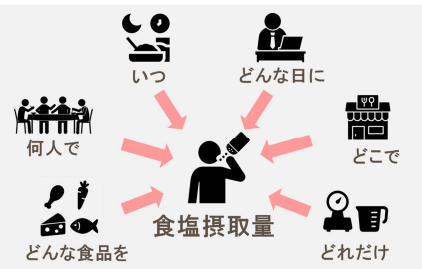
Salt (sodium) intake can vary across meals depending on the meal context and food types, including what and how much was consumed and where, when, and with whom it was consumed. However, their dynamic associations remain unclear. This study examined how meal context and food types are associated with salt intake at meals.
Methods
This cross-sectional analysis used data from 2757 adults aged 18–79 years. Ecological momentary assessment was conducted using eight-day dietary records to obtain information on meal context, food types, and salt intake.
Results
Multilevel linear regression analysis of 63,239 meals showed a higher absolute salt intake (g/meal) at lunch (β: 0.47, 95% CI: 0.44, 0.51) and dinner (β: 0.84, 95% CI: 0.80, 0.88) than at breakfast. In addition, salt intake from meals eaten on non-working or non-school days (β: 0.10, 95% CI: 0.06, 0.13), in restaurants (β: 0.40, 95% CI: 0.34, 0.45), and with one other person (β: 0.08, 95% CI: 0.05, 0.12) was higher than that from meals eaten on working or school days, at home, and alone, respectively. Regarding food types, salt intake was significantly higher in meals containing staple foods (e.g., rice and bread), especially noodles (β: 2.29, 95% CI: 2.23, 2.36), as well as soup (β: 1.06, 95% CI: 1.03, 1.09), pickles (β: 0.72, 95% CI: 0.68, 0.75), reduced-salt seasonings (β: 0.35, 95% CI: 0.23, 0.47), herbs and spices (β: 0.13, 95% CI: 0.10, 0.16), citrus juice and vinegar (β: 0.30, 95% CI: 0.26, 0.34), moderately processed meat and seafood (β: 0.59, 95% CI: 0.56, 0.62), highly processed meat and seafood (β: 0.58, 95% CI: 0.55, 0.61), and alcoholic beverages (β: 0.36, 95% CI: 0.32, 0.41) than in meals without these foods. Consumption of salt-based seasonings and vegetables was positively associated with salt intake, whereas consuming fruit was associated with lower salt intake (β: -0.12, 95% CI: -0.15, -0.09). Using salt intake density (g/100 kcal) per meal instead of absolute salt intake showed generally similar associations.
Conclusions
Meal context and food types were associated with salt intake. These findings would be useful for developing practical strategies for reducing salt intake.