2025-07-07 国立遺伝学研究所
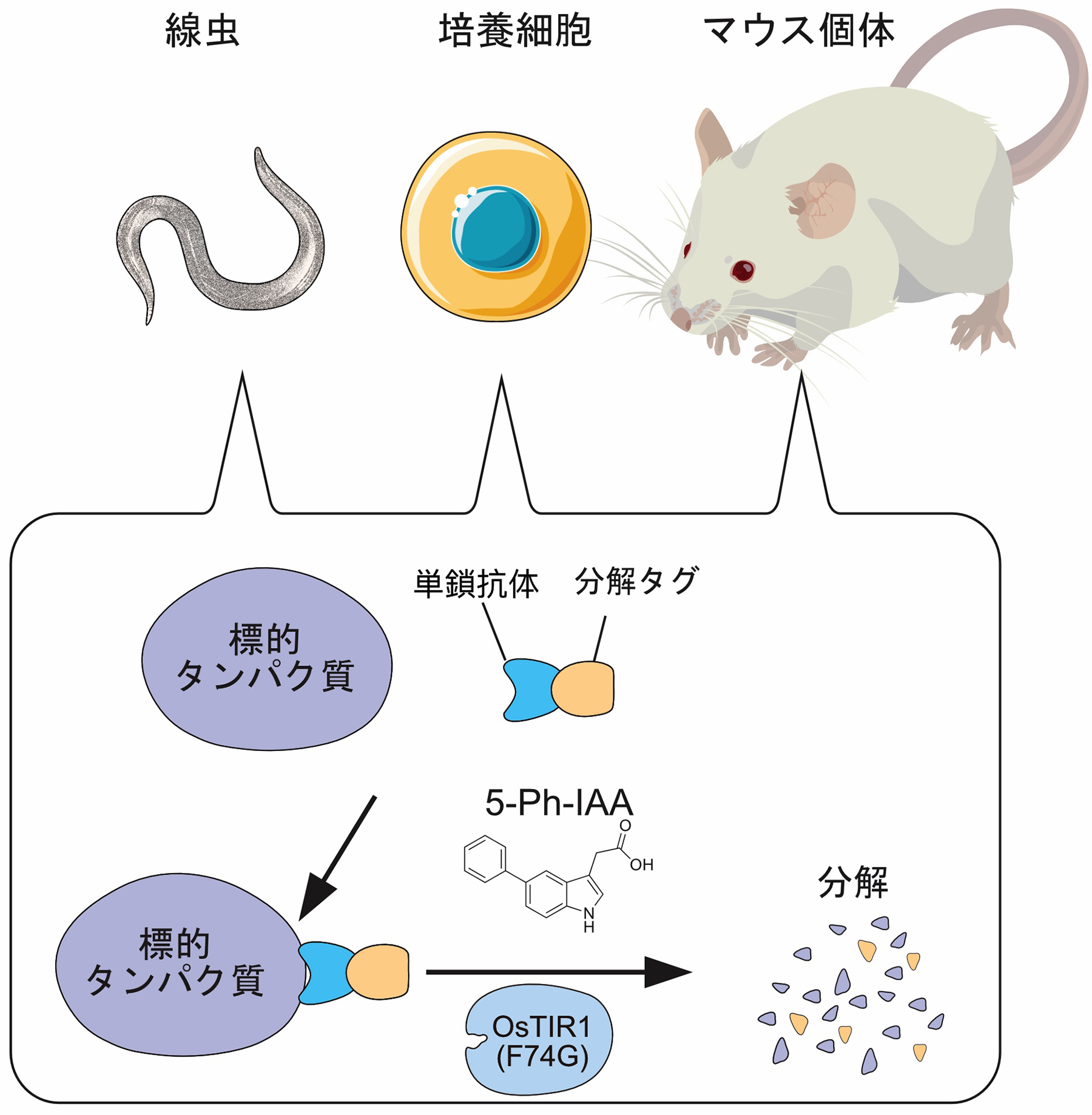 図:単鎖抗体AID2法により、分解タグを付加していないタンパク質が認識されて、5-Ph-IAA存在下で分解される。
<関連情報>
- https://www.nig.ac.jp/nig/ja/2025/07/research-highlights_ja/rh20250704.html
- https://journals.biologists.com/jcs/article-abstract/138/13/jcs263961/368488/A-single-chain-antibody-based-AID2-system-for?redirectedFrom=fulltext
一本鎖抗体を用いたAID2システムによるGFPタグ付きおよびタグなしタンパク質の条件分解 A single-chain antibody-based AID2 system for conditional degradation of GFP-tagged and untagged proteins
Moutushi Islam,Takefumi Negishi,Naomi Kitamoto,Yuki Hatoyama,Kanae Gamo,Ken-ichiro Hayashi,Masato T. Kanemaki
Journal of Cell Science Published:04 July 2025
DOI:https://doi.org/10.1242/jcs.263961
ABSTRACT
Protein knockdown using an improved auxin-inducible degron (AID2) technology has proven to be a powerful tool for studying protein function. The current approach requires the fusion of target proteins with a degron tag, a process typically achieved through CRISPR knock-in. However, knock-in remains challenging in non-model organisms and humans, limiting the broader applicability of AID2. To overcome this limitation, we developed a single-chain antibody AID2 (scAb-AID2) system. This approach employs an adaptor composed of a single-chain antibody fused with a degron, which recognizes a target protein and induces rapid degradation in the presence of the inducer 5-Ph-IAA. We demonstrated that scAb-AID2, in combination with an anti-GFP nanobody, degraded GFP-fused proteins in human cells and Caenorhabditis elegans. Furthermore, we showed that endogenous p53 and H/K-RAS were conditionally degraded in cells expressing an adaptor encoding an anti-p53 nanobody and -RAS monobody, respectively, and led to aphidicolin sensitivity in cell culture and growth inhibition in mouse xenografts. This study paves the way for broader application of AID2-based target depletion in model and non-model organisms and for advancing therapeutic strategies.