2025-07-17 ロックフェラー大学
<関連情報>
- https://www.rockefeller.edu/news/38042-scientists-discover-new-method-for-reprograming-organelles/
- https://www.nature.com/articles/s41586-025-09207-4
多相核小体のRNA駆動型構造のマッピングと工学的解析 Mapping and engineering RNA-driven architecture of the multiphase nucleolus
Sofia A. Quinodoz,Lifei Jiang,Aya A. Abu-Alfa,Troy J. Comi,Hongbo Zhao,Qiwei Yu,Lennard W. Wiesner,Jordy F. Botello,Anita Donlic,Elizabeth Soehalim,Prashant Bhat,Christiane Zorbas,Ludivine Wacheul,Andrej Košmrlj,Denis L. J. Lafontaine,Sebastian Klinge & Clifford P. Brangwynne
Nature Published:02 July 2025
DOI:https://doi.org/10.1038/s41586-025-09207-4
Abstract
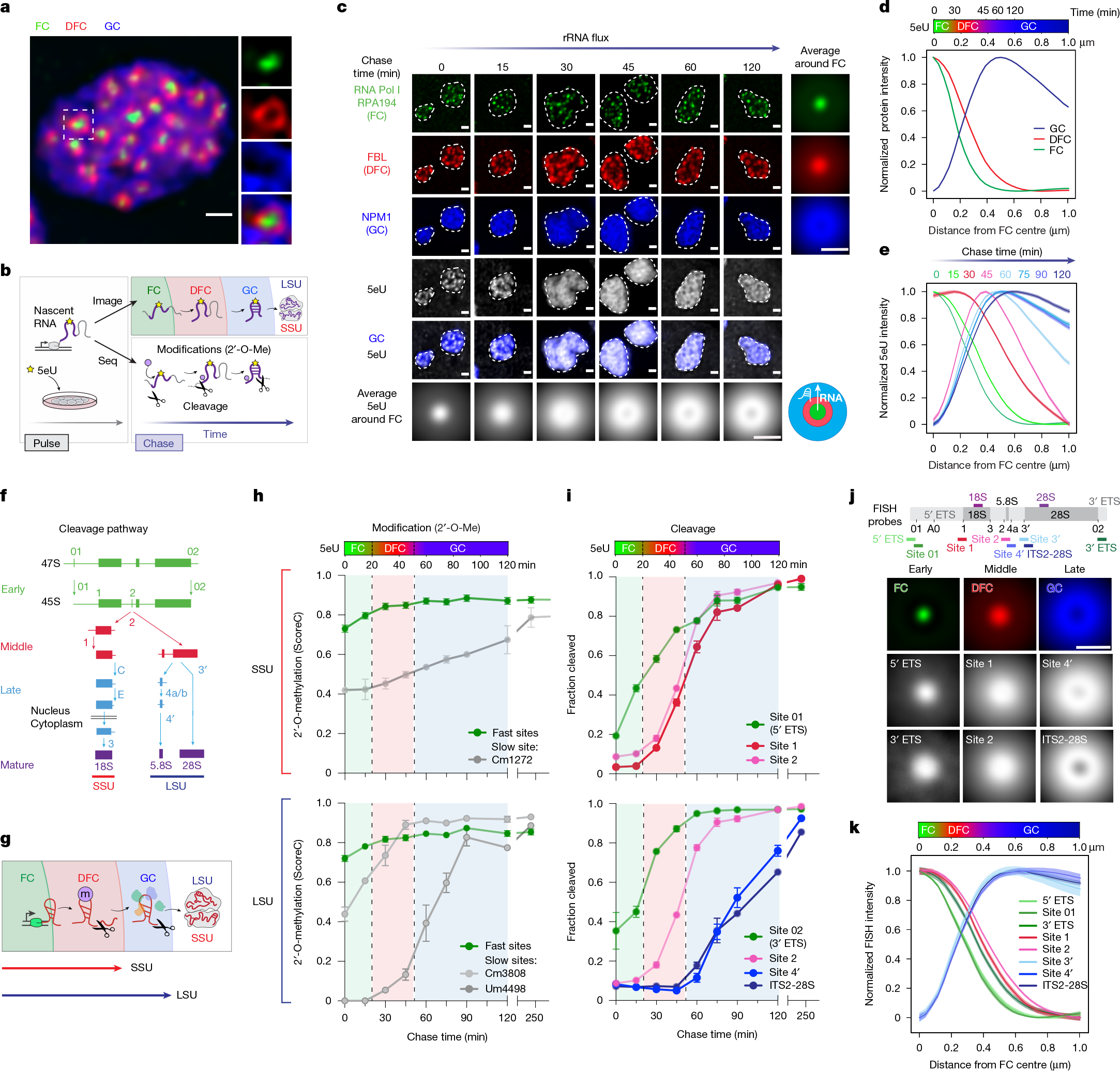
Biomolecular condensates are key features of intracellular compartmentalization1,2. As the most prominent nuclear condensate in eukaryotes, the nucleolus is a multiphase liquid-like structure in which ribosomal RNAs (rRNAs) are transcribed and processed, undergoing multiple maturation steps to form the small (SSU) and large (LSU) ribosomal subunits3,4,5. However, how rRNA processing is coupled to the layered organization of the nucleolus is poorly understood owing to a lack of tools to precisely monitor and perturb nucleolar rRNA processing dynamics. Here we developed two complementary approaches to spatiotemporally map rRNA processing and engineer de novo nucleoli. Using sequencing in parallel with imaging, we found that rRNA processing steps are spatially segregated, with sequential maturation of rRNA required for its outward movement through nucleolar phases. By generating synthetic nucleoli in cells using an engineered rDNA plasmid system, we show that defects in SSU processing can alter the ordering of nucleolar phases, resulting in inside-out nucleoli and preventing rRNA outflux, while LSU precursors are necessary to build the outermost layer of the nucleolus. These findings demonstrate how rRNA is both a scaffold and substrate for the nucleolus, with rRNA acting as a programmable blueprint for the multiphase architecture that facilitates assembly of an essential molecular machine.