2025-08-05 東京科学大学
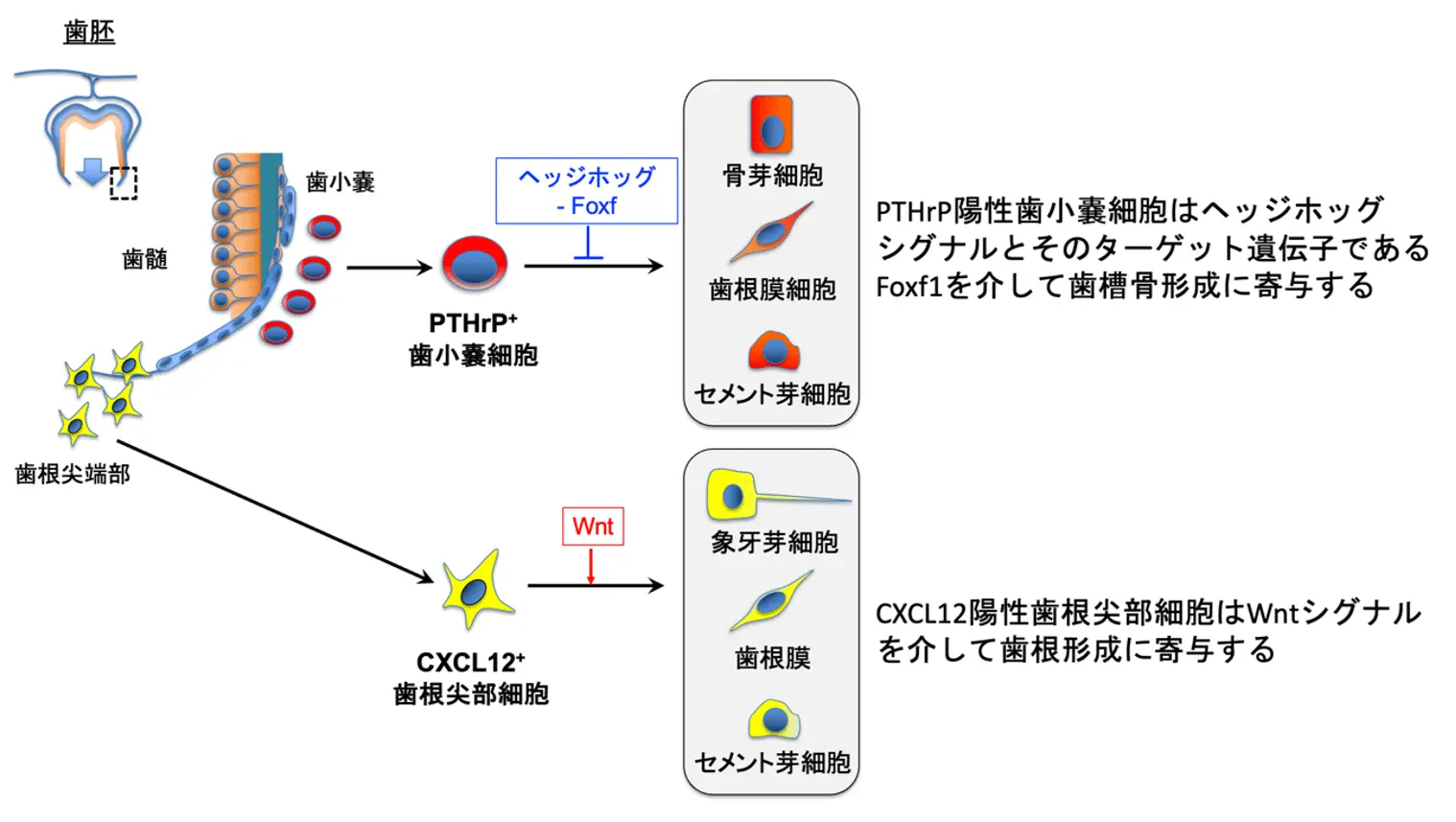
図1.本研究の概要
歯小嚢に存在するPTHrP陽性の間葉系細胞が、ヘッジホッグ-Foxfシグナルを介して歯槽骨の形成に寄与すること、また歯根尖部に存在するCXCL12陽性の間葉系細胞が、Wntシグナルを介して歯根形成に重要な役割を果たすことを、細胞系譜追跡により明らかにした。
<関連情報>
- https://www.isct.ac.jp/ja/news/08er2yabpq0a
- https://www.nature.com/articles/s41467-025-61050-3
- https://www.nature.com/articles/s41467-025-61048-x
ヘッジホッグ–フォックスF軸が歯胚由来の歯槽骨形成を調整する A Hedgehog–Foxf axis coordinates dental follicle-derived alveolar bone formation
Mizuki Nagata,Gaurav T. Gadhvi,Taishi Komori,Yuki Arai,Chiaki Tsutsumi-Arai,Angel Ka Yan Chu,Seth N. Nye,Yuntao Yang,Shion Orikasa,Akira Takahashi,Peter Carlsson,W. Jim Zheng,Joshua D. Welch,Noriaki Ono & Wanida Ono
Nature Communications Published:02 July 2025
DOI:https://doi.org/10.1038/s41467-025-61050-3
Abstract
The alveolar bone is a specialized mineralized structure supporting the lifelong functionality of the tooth in mastication. The alveolar bone develops from the dental follicle (DF) during tooth root formation due to deliberate epithelial–mesenchymal interactions. However, how DF progenitor cell fates are regulated toward alveolar bone osteoblasts remains unknown. We find that Hedgehog signaling activities are transiently activated during the onset of tooth root formation and alveolar bone formation. Parathyroid hormone-related protein (PTHrP)-expressing DF cells are highly responsive to Hedgehog signaling, yet constitutive Hedgehog activation using Pthrp-creER and Ptch1-floxed alleles potently suppresses alveolar osteoblast and ligament differentiation of PTHrP+ DF cells, resulting in striking susceptibility to alveolar bone loss. Concomitant inactivation of Hedgehog-target Foxf1 factor in Hedgehog-activated PTHrP+ DF cells partially rescued alveolar bone defects. Therefore, the Hedgehog–Foxf pathway needs to be suppressed to drive alveolar bone osteoblast fates of PTHrP+ DF cells, unraveling a unique tooth-specific mechanism of bone formation requiring deliberate on-off regulations of Hedgehog signaling.
Wnt誘導型CXCL12発現頂部乳頭前駆細胞が歯根形成を促進する Wnt-directed CXCL12-expressing apical papilla progenitor cells drive tooth root formation
Mizuki Nagata,Gaurav T. Gadhvi,Taishi Komori,Yuki Arai,Hiroaki Manabe,Angel Ka Yan Chu,Ramandeep Kaur,Meer Ali,Yuntao Yang,Chiaki Tsutsumi-Arai,Yuta Nakai,Yuki Matsushita,Nicha Tokavanich,W. Jim Zheng,Joshua D. Welch,Noriaki Ono & Wanida Ono
Nature Communications Published:01 July 2025
DOI:https://doi.org/10.1038/s41467-025-61048-x
Abstract
The tooth root is a critical component of the tooth anchored to surrounding alveolar bones. Tooth root formation is driven by cells in the apical papilla (AP) that generate new dentin-forming odontoblasts at the root-forming front. Mesenchymal stem cells have been isolated from AP for regenerative use; however, how AP cells physiologically coordinate tooth root formation remains undefined. We find that CXCL12+ cells emerge in AP under hypoxic environments at the onset of tooth root formation. Using Cxcl12-creER-based cell-lineage analysis, we further find that CXCL12+ AP cells contribute not only to odontoblasts but also to cementum-forming cementoblasts of the elongating root, while showing plasticity to alveolar bone osteoblasts under regenerative conditions. Canonical Wnt inactivation inhibits odontoblast fates of CXCL12+ AP cells and induces substantial root truncation, with their aberrant fibroblast fates suppressed by TGF-β receptor inhibitor galunisertib. Therefore, CXCL12+ AP cells maintain odonto-cementogenic fates in a Wnt-dependent manner, identifying these cells as pivotal dental mesenchymal progenitor cells driving tooth root formation with substantial plasticity.