2025-08-19 京都大学
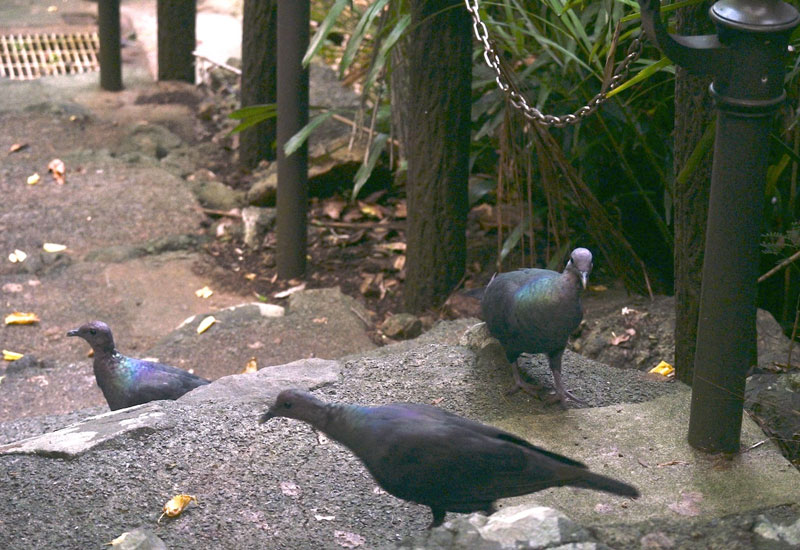
小笠原諸島の絶滅危惧種アカガシラカラスバト。2000年代には「幻の鳥」とまで言われたが、近年では住宅地の近くでも見られるようになった。(撮影:辻本大地、井鷺裕司)
<関連情報>
- https://www.kyoto-u.ac.jp/ja/research-news/2025-08-19
- https://www.kyoto-u.ac.jp/sites/default/files/2025-08/2508_CommsBio_Isagi_relj%20web-971edfbc3b13cad8089f05c1625fe937.pdf
- https://www.nature.com/articles/s42003-025-08476-z
絶滅の危機から回復中の島固有のハトにおける遺伝的浄化 Genetic purging in an island-endemic pigeon recovering from the brink of extinction
Daichi Tsujimoto,Mayo Takayanagi,Jyunko Ishii,Ryouko Sakashita,Kazuo Horikoshi,Hajime Suzuki & Yuji Isagi
Communications Biology Published:15 July 2025
DOI:https://doi.org/10.1038/s42003-025-08476-z
Abstract
In many endangered species with increased homozygosity, population recovery is limited by expressed deleterious mutations. In contrast, the critically endangered red-headed wood pigeon, endemic to an isolated oceanic archipelago of ~100 km2, experienced a dramatic population increase three years after the removal of introduced predators, despite being nearly extinct in the 2000s. To understand the reason for this recovery, we sequenced and analysed its genome. We find that over 80% of the genome is homozygous due to centuries of inbreeding, yet the frequency of highly deleterious mutations is lower than in widespread conspecifics. Linkage disequilibrium-based analysis suggests that the effective population size declined from several thousand to fewer than a hundred in the early 20th century due to human impacts. Gradual inbreeding in a historically small population before human impact may have purged part of the mutation load, facilitating the recovery. Our study highlights the role of historical demography in the persistence of bottlenecked populations, with implications for biological conservation.