2025-08-26 名古屋大学
<関連情報>
- https://www.nagoya-u.ac.jp/researchinfo/result/2025/08/post-868.html
- https://www.nagoya-u.ac.jp/researchinfo/result/upload_images/200250826_itbm.pdf
- https://www.nature.com/articles/s41477-025-02078-7
アポプラストのメタボローム解析による赤色光による気孔開口における葉肉メッセンジャーの解明 Apoplastic metabolomics reveals sugars as mesophyll messengers regulating guard cell ion transport under red light
Yotam Zait,Mengmeng Zhu,Eigo Ando,Yunqing Zhou,Adi Yaaran,Sunheng Yon,Mami Okamoto,Yuki Hayashi,Masami Y. Hirai,Timothy Jegla,Toshinori Kinoshita,Sixue Chen & Sarah M. Assmann
Nature Plants Published:25 August 2025
DOI:https://doi.org/10.1038/s41477-025-02078-7
Abstract
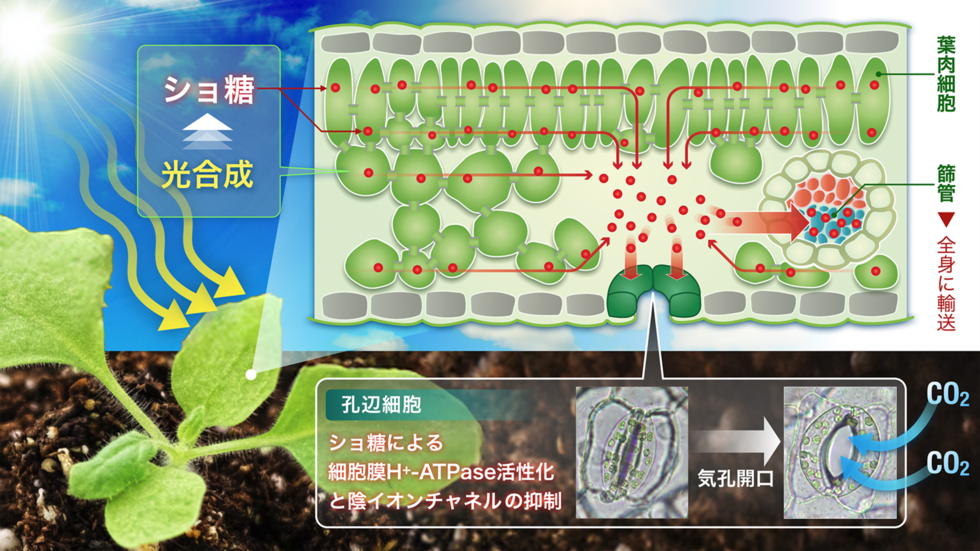
Guard cell pairs in the leaf epidermis enclose stomata, microscopic pores mediating CO2 uptake and water loss. Historical data suggest that signals from interior mesophyll tissue may modulate guard-cell regulation of stomatal apertures, but the molecular identity of any metabolite-based signals has remained elusive. We discovered that extracellular (apoplastic) fluid from Arabidopsis thaliana and Vicia faba enhances red-light-induced stomatal opening. Our extensive metabolomics analyses identified 448 apoplastic metabolites; among these, both sugars (photosynthetic products) and maleic acid increased under red light and caused enhanced stomatal opening. Immunohistochemical assays demonstrated sucrose upregulation of H+-ATPase phosphorylation, indicating increased ATPase activity. Patch clamp assays revealed that sucrose inhibits slow anion currents, thus opposing anion efflux. These impacts occurred at sucrose concentrations matching those present endogenously under red light. These regulatory influences promote guard-cell solute import and retention, which drive stomatal opening. Our research thus addresses the decades-long question concerning the existence, identity and mechanistic impact of mesophyll messengers that coordinate photosynthesis with stomatal response.