2025-08-25 京都大学iPS細胞研究所
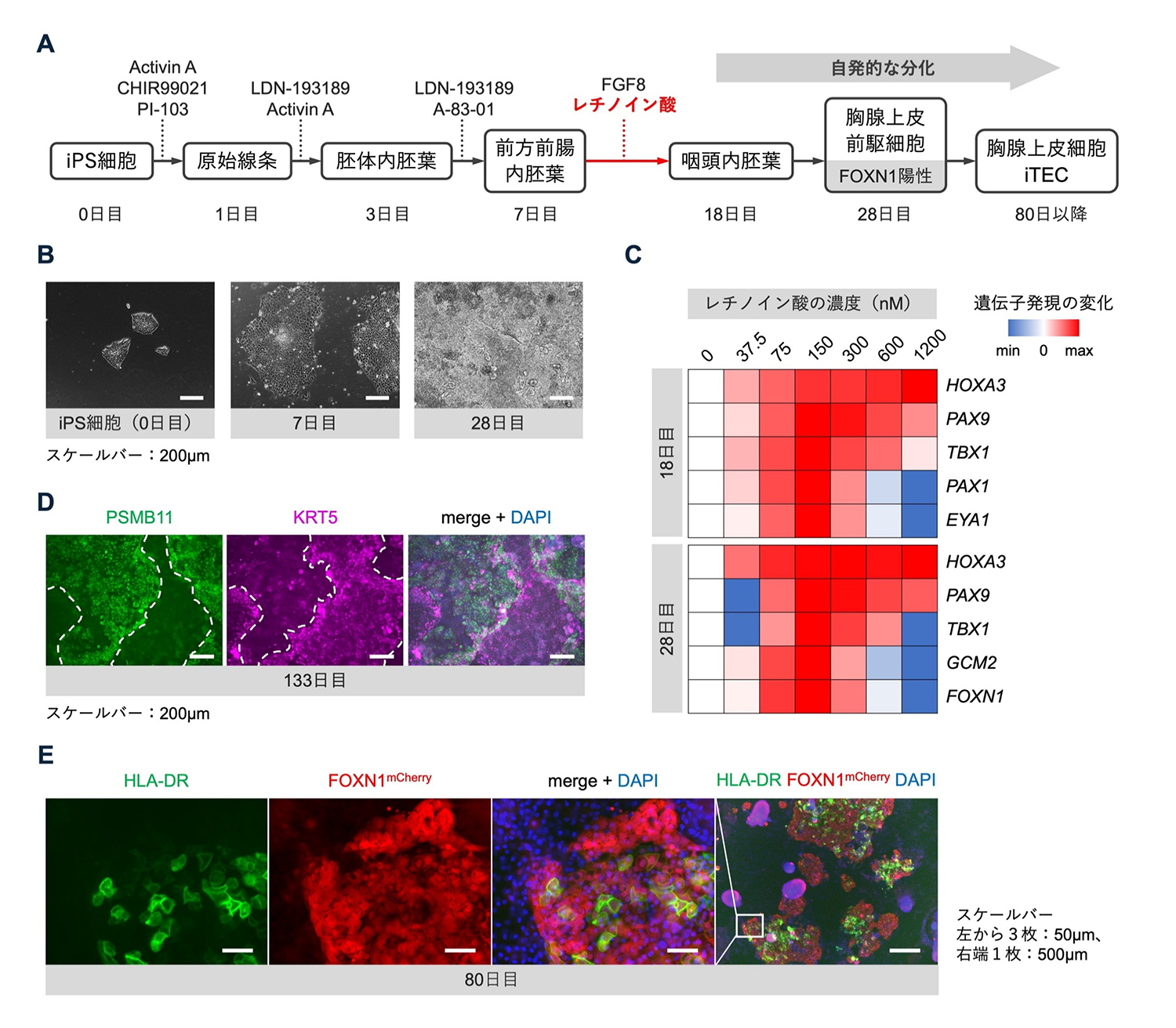 図1
図1
A:ヒトiPS細胞から胸腺上皮細胞(iTEC)への分化誘導の過程。
B:誘導した各時点の細胞の様子(明視野)。
C:レチノイン酸の濃度とHOXA3およびFOXN1の遺伝子発現誘導との関係。
D:皮質と髄質の胸腺上皮細胞で発現するタンパク質(皮質:PSMB11、髄質:KRT5)の免疫染色。2つの領域に分かれている。
E:FOXN1が発現すると赤い蛍光(mCherry)を発するレポーターiPS細胞株から分化誘導した胸腺上皮細胞(FOXN1mCherry)と成熟マーカー(HLA-DR)の染色。
<関連情報>
- https://www.cira.kyoto-u.ac.jp/j/pressrelease/news/250825-180000.html
- https://www.nature.com/articles/s41467-025-62523-1
iPS細胞に基づくin vitroモデルは、ヒト胸腺上皮の発生と多系分化を再現する An iPSC-based in vitro model recapitulates human thymic epithelial development and multi-lineage specification
Yann Pretemer,Yuxian Gao,Kaho Kanai,Takuya Yamamoto,Kohei Kometani,Manami Ozaki,Karin Nishigishi,Tadashi Ikeda,Huaigeng Xu,Akitsu Hotta & Yoko Hamazaki
Nature Communications Published:25 August 2025
DOI:https://doi.org/10.1038/s41467-025-62523-1
Abstract
Thymic epithelial cells (TEC) are crucial in supporting T cell development, but their high heterogeneity and difficulty of isolation pose obstacles to their study in humans. Particularly, how diverse TEC lineages arise from a common progenitor remains poorly understood. To address this, here we establish a human iPSC-based model of thymus organogenesis capable of deriving these lineages in vitro. Through controlled retinoid signaling followed by self-directed differentiation, we obtain FOXN1+ TEC progenitor-like cells and diverse mature MHCII+ populations resembling cortical and medullary TECs, allowing us to infer their developmental trajectories. Upon thymocyte co-culture, induced TECs support the generation of naïve T cells with diverse TCR repertoires and further develop into AIRE+ and mimetic TEC subpopulations. Our system provides a fully in vitro model of human TEC differentiation from early fate specification to late-stage maturation, offering new insights into human thymus development and potential regenerative applications for congenital thymic disorders.