
2025-08-28 ブラウン大学
<関連情報>
- https://www.brown.edu/news/2025-08-28/extremist-brains
- https://www.apa.org/pubs/journals/releases/psp-pspa0000460.pdf
- https://www.science.org/doi/10.1126/sciadv.abq5920
政治的極端主義者はイデオロギーの違いにもかかわらず類似した神経処理を示す Politically Extreme Individuals Exhibit Similar Neural Processing Despite Ideological Differences
Daantje de Bruin and Oriel FeldmanHall
Journal of Personality and Social Psychology Published:2025
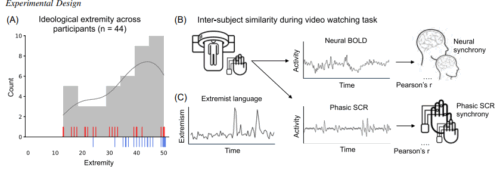
The current state of political polarization in the United States encompasses a growing divide between partisans and a shift toward more extreme ideologies. Although rising ideological extremism poses societal challenges, the mechanisms supporting extreme views remain uncharacterized. Leveraging a combination of neurophysiological methods, we show that regardless of which side of the political aisle an individual is on, those with more extreme views show heightened neural activity to politically charged content in brain regions implicated in affective processing—including the amygdala, periaqueductal gray, and posterior superior temporal sulcus. Moreover, we observe that those who share an extreme perspective—even when they do not share an ideology—exhibit increased neural synchronization in the broader posterior superior temporal sulcus region while consuming political content. For those on the most extreme ends of the ideological spectrum, this effect is further influenced by listening to extreme language. Finally, we find that shared arousal, measured through galvanic skin conductance responses, modulates the strength of coupling between shared extremity and neural synchrony. Together, our findings suggest a role for affect in shaping ideological extremity, which helps explain why those at the far ends of the political spectrum come to view the world through a shared, extreme lens.
共有神経表現と政治的コンテンツの時間的セグメンテーションがイデオロギー的類似性を予測する Shared neural representations and temporal segmentation of political content predict ideological similarity
Daantje de Bruin, Jeroen M. van Baar, Pedro L. Rodríguez, and Oriel FeldmanHall
Science Advances Published:1 Feb 2023
DOI:https://doi.org/10.1126/sciadv.abq5920
Abstract
Despite receiving the same sensory input, opposing partisans often interpret political content in disparate ways. Jointly analyzing controlled and naturalistic functional magnetic resonance imaging data, we uncover the neurobiological mechanisms explaining how these divergent political viewpoints arise. Individuals who share an ideology have more similar neural representations of political words, experience greater neural synchrony during naturalistic political content, and temporally segment real-world information into the same meaningful units. In the striatum and amygdala, increasing intersubject similarity in neural representations of political concepts during a word reading task predicts enhanced synchronization of blood oxygen level–dependent time courses when viewing real-time, inflammatory political videos, revealing that polarization can arise from differences in the brain’s affective valuations of political concepts. Together, this research shows that political ideology is shaped by semantic representations of political concepts processed in an environment free of any polarizing agenda and that these representations bias how real-world political information is construed into a polarized perspective.

