2026-03-17 フランス国立科学研究センター(CNRS)
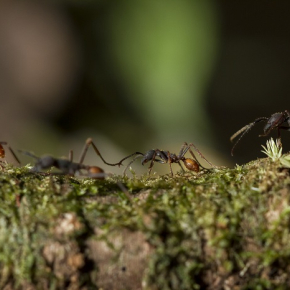
© Denis Palanque
<関連情報>
- https://www.cnrs.fr/en/press/unique-chemistry-french-guianas-army-ant-venom
- https://onlinelibrary.wiley.com/doi/10.1111/mec.70290
グンタイアリEciton hamatumの毒における階級特異的な機能的変異 Caste-Specific Functional Variation in the Venom of the Army Ant Eciton hamatum
Axel Touchard, Samuel D. Robinson, William Atherton, Jérôme Orivel, Irina Vetter, Corrie S. Moreau
Molecular Ecology Published: 17 March 2026
DOI:https://doi.org/10.1111/mec.70290
ABSTRACT
In ants, division of labour is often associated with caste-specific adaptations. In this study, we examined the morphology of the venom apparatus (venom reservoir volume and sting length) and the composition and activity of the venom across castes (soldier, submajor and media/minor) of the army ant Eciton hamatum to investigate how caste differentiation influences venom traits. Morphometric analyses revealed that soldiers have larger venom reservoirs and longer stings, consistent with their specialised role in defending the colony against vertebrates. Integrative venom profiling using transcriptomics and mass spectrometry identified 11 venom peptides, including a glycopeptide bearing a complex N-Glycan. Notably, soldiers had a streamlined venom peptide composition compared with other castes. Despite this reduced complexity, soldier venom was more potent in functional assays, showing enhanced paralytic effects on insect prey and stronger pain-inducing activity on vertebrate neurons. Chymotrypsin enzymes, more abundant in the venoms of soldier castes, may also serve a pre-digestive role. This pattern suggests an evolutionary trade-off favouring a limited set of highly effective components tailored to the dual function of defence and predation in soldiers.